
For years, Linnworks has held a solid reputation among multichannel sellers. The automation rules were genuinely useful, the European marketplace integrations ran deep, and the 2022 SkuVault warehouse-management acquisition added capabilities the platform had been missing. It worked.
Then, Marlin Equity Partners took a majority stake, and the experience changed. Renewal quotes started landing with three and four-figure percentage increases. Support tickets sat open for weeks. The cloud migration introduced bugs that went unresolved for months. Longtime users, some of whom’d been on the platform for a decade, suddenly found themselves shopping for replacements with 30 days before their next invoice.
If you’re reading this, there’s a decent chance you’ve had some version of that experience. So rather than a surface-level listicle, this is a proper breakdown of the five strongest alternatives available right now, what each one actually does well, where the gaps are, and which type of operation each one fits.
TLDR: Quick Comparison
| Platform | Best For | Starting Price | G2 Rating | Free Trial |
| Willow Commerce | AI-powered multichannel ops + shipping optimization | $499/mo | 5/5 | Yes (14-day) |
| Cin7 | SMBs needing inventory + manufacturing + POS | $349/mo | 4.3/5 | Yes (14-day) |
| Brightpearl | Mid-market retailers with integrated accounting | ~$1,500+/mo (custom) | 4.5/5 | No |
| Extensiv | Brands with complex 3PL fulfillment networks | ~$400/mo | 4.2/5 | No |
| Zoho Inventory | Budget-conscious SMBs and Zoho ecosystem users | Free; $29/mo paid | 4.5/5 (Capterra) | Yes (14-day) |
The Real Reasons Sellers Are Leaving Linnworks
These aren’t hypothetical pain points. They come directly from G2, Trustpilot, Capterra, and community threads where sellers share migration stories in real time.
The pricing situation dominates every conversation. After the Marlin Equity acquisition, users across Trustpilot describe renewal quotes jumping from a few hundred pounds per month to five-figure annual commitments. One seller reported going from £1,800 to £52,000. Another saw a 384% increase to £32,000/year. The Linnworks pricing page now requires a sales call for any quote, which indicates how comfortable they are with public pricing.
Support quality dropped in parallel. Early 2026 Trustpilot reviews describe an offshore development team operating on a completely different timeline from frontline agents, creating a bottleneck in which tickets are acknowledged but never actually resolved. Linnworks’ own support forum has threads from users calling out bugs that have been open for years. One user put it bluntly: they felt like unpaid beta testers for a product that was supposed to be production-ready.
Then there’s the reporting problem. WebRetailer’s review details how the platform fails to properly track Amazon FBA returns, only supports a single cost per product (making international margin tracking impossible), and produces financial data that multiple users describe as unreliable. For sellers who need an accurate P&L by channel, that’s not a minor inconvenience.
And the contracts. Even sellers whose businesses were literally shutting down reported being unable to cancel without paying out the remaining term.
None of this means Linnworks fails every seller in every scenario. For UK-based operations with moderate volumes and a focus on the European marketplace, automation and channel depth still deliver. But for growing North American brands, or anyone blindsided by a pricing surprise, these are the platforms worth your evaluation time.
What Actually Matters When You’re Switching
Replacing one set of problems with another helps nobody. Before comparing platforms, a few criteria help separate the tools that scale from those you’ll need to migrate away from.
Real-time inventory synchronization across every warehouse and sales channel is baseline, but execution quality varies enormously. Same for order routing logic, the rules that determine how orders get split, prioritized, and directed to the right fulfillment location as volumes climb.
Multi-carrier shipping with automated rate comparison saves meaningful money at scale. The best platforms use AI to select the cheapest carrier for each shipment based on weight, dimensions, destination, and speed, without requiring manual rate checks for every order.
Marketplace coverage needs to reflect where you actually sell. Amazon, Walmart, eBay, and Shopify are table stakes. But TikTok Shop, Wayfair, Target Plus, and EDI connectivity for wholesale are increasingly non-negotiable for mid-market sellers expanding their channel mix.
And here’s one that doesn’t show up on feature comparison charts: ownership structure. The pattern of private equity acquisitions leading to aggressive price hikes, support cuts, and feature stagnation is well-documented across ecommerce software. It happened at Linnworks. It’s happened elsewhere. Platforms that remain independently funded tend to stay more aligned with the people actually using them.
1. Willow Commerce
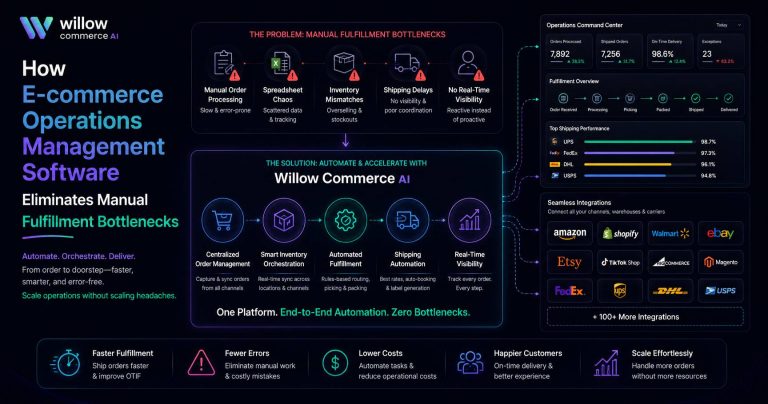
Willow Commerce was founded in 2017 and is based in New Jersey. The platform brings order management, inventory control, multichannel listing, and shipping optimization into a single system, currently managing over $350 million in annual GMV across 80+ channel integrations.
What makes this one particularly interesting as a Linnworks replacement is that it gets something most order management platforms get wrong: shipping. Most tools in this category treat carrier management as an afterthought or bolt it on as a paid add-on. Willow Commerce built multi-carrier rate shopping directly into the core product, with AI-driven carrier selection across UPS, FedEx, USPS, DHL, Amazon Shipping, and LTL freight carriers. The founding team includes former UPS and FedEx carrier executives who negotiated pre-discounted rates into the platform. The company claims this translates to 10-15% savings compared to standalone shipping tools.
That LTL freight support deserves its own mention. Almost no one in this category handles both parcel and Less-Than-Truckload freight on a single platform. If you’re shipping bulky items, palletized wholesale orders, or anything that exceeds parcel dimensions, you probably know the pain of managing a separate freight system alongside your parcel workflow. Having both under one roof eliminates a real operational seam.
Inventory management covers real-time sync across channels and warehouses, AI-powered demand forecasting, automated reorder points, and a built-in WMS (Skustack) with barcode pick-pack-ship workflows. Multi-warehouse routing automatically routes orders to the nearest fulfillment center, and ship-from-store is supported for omnichannel retail brands.
Channel coverage skews heavily toward North America: Amazon (Seller Central and Vendor Central), Walmart and Walmart DSV, eBay, Etsy, Wayfair, Target, Best Buy, Macy’s, Kohl’s, Nordstrom, Home Depot, TikTok Shop, Newegg, and Faire. Shopping carts include Shopify, Shopify Plus, BigCommerce, Magento, and WooCommerce, with EDI for B2B wholesale.
Pricing starts at $499/month for the Startup tier (under 2,000 monthly orders) and scales with volume. Every plan includes unlimited products, stores, users, warehouses, and integrations. No feature tiers, no per-user charges, no module add-ons. Month-to-month, cancel anytime. There’s a 14-day free trial.
A few things work in its favor beyond features. The company is independently operated with no private equity ownership, which matters given what PE involvement did to Linnworks’ pricing. Onboarding typically wraps in 2 to 3 weeks rather than the months that legacy platforms require. And the all-inclusive pricing model means the number you see at signup is the number you pay, period.
The trade-off is maturity. Willow Commerce is newer and doesn’t carry the volume of third-party reviews that established competitors have accumulated. Sellers whose operations center on European marketplaces may also find the North American channel depth more relevant than necessary.
This fits growing multichannel brands in North America running multi-warehouse fulfillment, significant shipping volumes, or operations that are tired of stitching together separate tools for inventory, orders, and shipping.

2. Cin7
Cin7 is the pick if your operation involves manufacturing, assembly, or a wholesale-retail hybrid. Two products sit under the Cin7 umbrella: Core (the former DEAR Inventory, aimed at SMBs) and Omni (mid-market, with EDI, multi-entity, and 3PL depth).
The reason Cin7 earns a spot on this list, while plenty of inventory tools don’t, is its manufacturing module. Bill of materials management, production scheduling, and assembly tracking are natively baked in. Linnworks never offered this. If you’re producing goods or kitting components into finished products, Cin7 handles that workflow without a separate system. The built-in POS and B2B portal round out a platform that genuinely covers both wholesale and direct-to-consumer selling.
Pricing is refreshingly transparent. Core starts at $349/month for 5 users and 2 integrations; Pro runs at $599/month; and Advanced hits $999/month for complex, high-volume setups. Omni is custom-quoted.
Here’s the honest concern. Cin7 acquired DEAR Inventory, and G2 reviews tell a familiar story: support quality declined sharply after the acquisition. Users report that features promised in updates still don’t function correctly months later. The platform is backed by EQT Partners (through Acumatica), which introduces the same category of long-term pricing risk that pushed sellers away from Linnworks in the first place.
Small to mid-sized product businesses with manufacturing or assembly workflows, brands juggling wholesale and retail, or companies wanting affordable inventory management with point-of-sale capabilities will get the most out of this one. Just go in with eyes open about the PE ownership trajectory.
Also Read: Cin7 Alternatives
3. Brightpearl (by Sage)
Brightpearl calls itself a Retail Operating System. Unlike most platforms in this space that treat accounting as someone else’s problem, Brightpearl makes financial management the centerpiece. Sage Group acquired the company in 2022, and the Sage Intacct integration brings multi-entity financial management that’s genuinely hard to find elsewhere in ecommerce operations software.
This matters more than it might sound. When your accounting lives inside the same system that processes orders and manages inventory, you skip an entire category of reconciliation headaches. The Automation Engine processes orders at a pace that manual workflows can’t touch, and the retail-specific analytics track customer acquisition cost, return on ad spend, and lifetime value alongside operational metrics. Most inventory platforms don’t even attempt that.
Unlimited users on all plans is another differentiator that matters for seasonal businesses or teams with multiple departments accessing the system.
The reality check: this isn’t cheap or quick. Estimates put starting costs at around $1,500/month for mid-volume operations, with implementation running $5,000 to $20,000 and a go-live timeline of 90 to 120 days. G2 feedback points to a platform that can feel dated, with innovation slowing under Sage ownership. The setup is anything but plug-and-play, and US-based sellers consistently report slower support compared to UK counterparts.
Mid-market multichannel retailers doing $1 million or more annually, particularly those on Shopify Plus or BigCommerce who need back-office operations and accounting unified in one system, will find the investment justified. Everyone else might find it has more infrastructure than they need.
Also Read: Brightpearl Alternatives
4. Extensiv (formerly Skubana)
Extensiv exists for a specific type of operation: brands that distribute inventory across multiple third-party logistics providers and need a single control plane for all of it. The company formed when 3PL Central acquired Skubana, Scout Software, and CartRover between 2021 and 2022, and the Extensiv Network now connects to over 1,500 3PL warehouses.
That network is the real selling point. If you outsource fulfillment to two, three, or five different 3PLs and need centralized visibility into what’s where, what’s moving, and what’s running low, this kind of connectivity is genuinely difficult to replicate with other tools. The Orderbots automation engine handles complex order routing, and SKU-level profitability with FIFO costing gives your finance team granularity that most operations platforms skip entirely. G2 reviewers rate data synchronization at 9.8 out of 10, a notably high score.
The friction comes in two places. First, onboarding. Capterra users report setup fees around $7,000, a steep commitment before the platform even goes live. Second, reliability. Inventory sync errors causing overselling, backend performance issues, and bugs when running Order Manager and Warehouse Manager simultaneously recur in user feedback. The platform is backed by Mainsail Partners, so the PE pricing concern also applies here.
Software costs start around $400/month. This fits SMB- to mid-market multichannel brands, typically with 10 to 200 employees, that rely heavily on 3PL partners and need distributed fulfillment orchestrated from a single dashboard.
Also Read: Extensiv Alternatives
5. Zoho Inventory
Everything else on this list costs hundreds or thousands per month. Zoho Inventory has a free plan. A real one, with 50 orders per month and a single user included. Paid tiers start at $29/month for 500 orders, and the Enterprise plan caps at $249/month for 15,000 orders and 7 users.
For small businesses with straightforward operations, the value proposition is almost impossible to argue against. Barcode scanning, serial and batch tracking, composite items, and multi-channel order management are all included. Companies already running Zoho CRM, Zoho Books, or Zoho Commerce get native integrations that work without third-party middleware.
Where it breaks down is scale and complexity. Monthly order caps on every plan create a hard ceiling. Marketplace integrations are more limited than those of dedicated ecommerce platforms. Customization and advanced reporting are limited. And Capterra reviews note that support is available only 5 days a week, with response times slower than you’d expect for a paid product.
This is the right choice for early-stage ecommerce businesses, retail startups with lean operations, or companies already in the Zoho ecosystem who want inventory management that integrates directly with their existing tools. It’s not the right choice for anyone processing thousands of orders across multiple warehouses and marketplaces.
Full Feature Comparison
| Feature | Linnworks | Willow Commerce | Cin7 Core | Brightpearl | Extensiv | Zoho Inventory |
| Starting Price | ~$449/mo (custom) | $499/mo | $349/mo | ~$1,500+/mo (custom) | ~$400/mo | Free; $29/mo paid |
| Free Trial | No | Yes (14-day) | Yes (14-day) | No | No | Yes (14-day) |
| Built-in Shipping | Yes | Yes (parcel + LTL) | Limited | No | Yes | Via integrations |
| AI Capabilities | Spotlight AI (basic) | Rate shopping, demand forecasting | ForesightAI | Demand Planner (add-on) | Limited | Basic forecasting |
| Built-in WMS | Yes (SkuVault) | Yes (Skustack) | Yes | Yes | Yes | Basic |
| Native Accounting | No | Yes | Yes | Yes | No | Via Zoho Books |
| POS Included | No | No | Yes | Yes | No | No |
| Manufacturing/BOM | No | No | Yes | No | No | Composite items |
| LTL Freight Support | No | Yes | No | No | No | No |
| Unlimited Users | No | Yes | No | Yes | Yes | No |
| Go-Live Timeline | Weeks | 2-3 weeks | Self-serve/assisted | 90-120 days | 5 Weeks + high setup fee | Days to weeks |
| Ownership | Marlin Equity (PE) | Independent | EQT Partners (PE) | Sage (public) | Mainsail Partners (PE) | Zoho Corp. (private) |
Making the Decision
Skip the feature matrix for a moment and think about what actually broke with Linnworks for you. That tells you where to look.
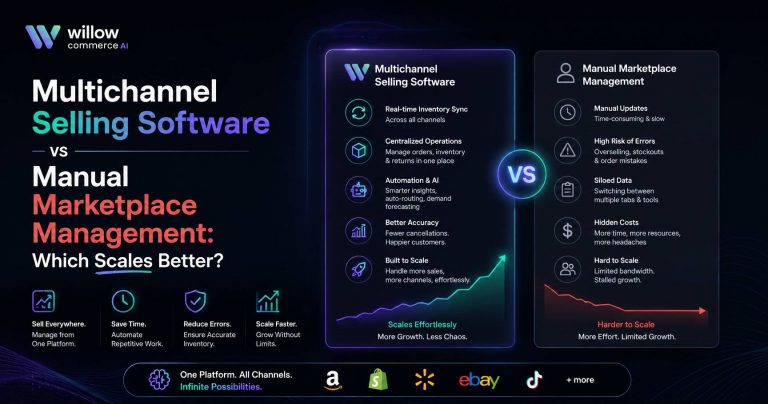
If the problem was pricing surprises compounded by limited shipping tools and inflexible workflows, Willow Commerce targets all three. All-inclusive pricing removes the module creep. Integrated multi-carrier shipping with AI rate optimization replaces standalone tools. And the independent ownership means pricing decisions aren’t filtered through PE return expectations.
If you manufacture products and Linnworks never had the BOM support you needed, Cin7 fills that gap at a lower entry price. Be aware of the PE ownership dynamic, though.
If your real frustration was financial reconciliation across channels and you’d rather have accounting built into your operations platform, Brightpearl is an option, provided you have the budget and patience for a longer implementation.
If your logistics run through multiple 3PL partners and visibility across that network is the bottleneck, Extensiv’s 3PL connections are a great advantage.
And if you’re early-stage, budget-constrained, or simply don’t need the operational complexity of mid-market tools, Zoho Inventory gets you running without financial risk.
Whatever you choose, start the evaluation before your next Linnworks renewal lands. The sellers who had the smoothest migrations were the ones who gave themselves three months instead of three weeks.
Frequently Asked Questions
Steep price increases following Marlin Equity Partners’ investment are the primary driver. Sellers report renewal quotes jumping 300 to 400% with minimal notice. Declining support quality, unresolved cloud migration bugs, gaps in Amazon FBA reporting, and rigid cancellation policies compound the frustration
For mid- to high-volume multichannel sellers in North America, Willow Commerce offers the widest range of needs on a single platform: order management, real-time inventory sync, multichannel listing, and multi-carrier shipping optimization with AI rate shopping, all at a single flat monthly price.
Willow Commerce is the best alternative to Linnworks. Willow Commerce begins at $499/month with all-inclusive pricing and no per-module charges.
Willow Commerce supports Amazon Seller Central, Amazon Vendor Central, Walmart Marketplace, and Walmart DSV with native integrations. Extensiv also provides strong connectivity to FBA and Walmart Fulfillment Services, particularly for brands running distributed fulfillment through 3PL partners.
Willow Commerce is the most complete single-platform option, combining real-time inventory sync, multi-warehouse management, and built-in multi-carrier shipping with AI rate comparison. It also supports LTL freight alongside parcel carriers, which no other platform on this list offers.
Timelines range widely. Willow Commerce typically completes onboarding in 2 weeks. Extensiv takes several weeks plus a significant setup investment. Brightpearl runs for 90 to 120 days due to the complexity of the accounting configuration. Zoho Inventory can be live in days for simpler operations. Plan for at least a month of overlap to validate data accuracy before cutting over.
Look at what happened to Linnworks pricing after the PE acquisition and decide for yourself. Cin7 (EQT Partners) and Extensiv (Mainsail Partners) carry the same ownership model. Willow Commerce remains independent, Zoho is privately held by Zoho Corporation, and Brightpearl sits under Sage, a publicly traded company. History suggests that PE-backed platforms face more pressure to extract margin from existing customers over time.
» Ready to ship smarter? Let Willow Commerce simplify your inventory and shipping management today.
» Start Your Free Trial
Disclaimer: The information in this article is based on publicly available data, user reviews on platforms like G2, Capterra, and Trustpilot, and third-party public research sources as of early 2026. Product features, pricing, and capabilities change over time. We encourage readers to verify details directly with each vendor before making a purchasing decision.