
Every multichannel ecommerce software provider claims to do the same three things: sync your inventory, centralize your orders, and connect to every marketplace you sell on. The marketing pages are nearly identical. The feature comparison tables are designed to make every tool look equally capable. And the demo always goes smoothly.
The reality is that these platforms differ enormously, and those differences only surface under real operational pressure. A missed inventory sync during a flash sale. A TikTok Shop order that doesn’t route through your standard fulfillment workflow. A “real-time” analytics dashboard that’s actually pulling data from a 24-hour-old snapshot. These are the failures that cost money, and they never show up in a feature checklist.
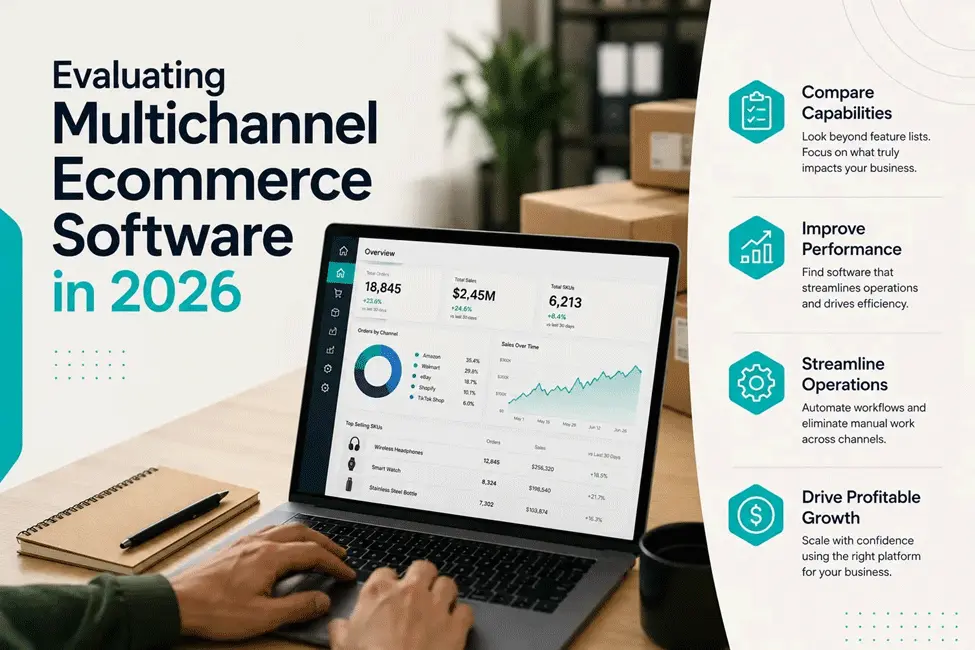
This guide is built for sellers who have moved beyond surface-level comparisons and are ready to evaluate what actually matters when choosing an ecommerce operations platform in 2026.
How to Choose Ecommerce Operations Software
The first mistake most sellers make is starting with features. They build a spreadsheet of platforms, list out capabilities, and pick the one with the most checkmarks. This approach fails because it treats all features as equal and assumes that “has feature X” means “does feature X well.”
A better starting point is your operational bottlenecks. What’s actually slowing you down or costing you money right now?
If you’re honest about where friction lives in your business, the evaluation criteria sort themselves. Here are the questions that matter more than any feature list:
- Where does your team spend the most manual time each day?
- Copying order data between platforms
- Reconciling inventory across channels
- Generating shipping labels one marketplace at a time
- Manually adjusting prices to stay competitive
- Which operational failures have cost you money in the last 90 days?
- Overselling because the inventory didn’t sync fast enough
- Late shipments that violated marketplace SLAs
- Stockouts on your best-selling SKUs
- Returns caused by listing inaccuracies across channels
- What happens when order volume spikes?
- Does your current system handle 3x normal volume without breaking?
- Do you need to add temporary staff just to process orders during peak periods?
- Can your warehouse workflows keep pace, or do pick errors increase under pressure?
The platform that solves your most expensive problems is worth more than the one with the longest feature list. A seller losing $10,000 a month to overselling needs a rock-solid inventory sync above everything else. A seller hemorrhaging margin on shipping needs carrier rate shopping and fulfillment optimization. Start with the pain, not the brochure.
Ownership Structure Matters More Than You Think
Something most evaluation guides skip entirely: who owns the platform and how it was built.
The multichannel ecommerce software market has gone through a wave of consolidation. Private equity firms have acquired multiple point solutions and stitched them together under a single brand name. The result is often a platform that looks unified on the website but operates as disconnected products behind the scenes, with separate databases, separate logins, and inconsistent data flows between modules.
This isn’t theoretical. Sellers on acquired-and-merged platforms regularly report:
- Inventory data doesn’t match between the “inventory module” and the “order module” because they were originally separate products
- Features that disappeared or degraded after an acquisition because the new parent company prioritized cost-cutting over development
- Support quality dropped when the founding team was replaced by a scaled-down customer service operation
- Pricing that increased significantly post-acquisition, with new per-module fees or usage-based charges layered on top
Platforms built as a single system from day one avoid these problems at the architectural level. When catalog management, order processing, inventory sync, warehouse management, and shipping all share the same database and the same codebase, data consistency is a given, not a feature you hope works.
Multichannel Ecommerce Platform Evaluation Checklist
Rather than a generic feature matrix, this checklist focuses on the operational questions that separate capable platforms from marketing-grade ones. Use it during demos, trials, and vendor conversations.
Inventory Sync
- What is the sync architecture?
- Webhook-driven (real-time push) or polling-based (periodic pull)?
- If polling, what’s the interval? Every 5 minutes? 15? 30?
- Under peak load, does the sync interval degrade?
- Does the platform support variation-level tracking?
- Can it handle SKUs with size, color, and material variants across channels where each marketplace structures variations differently?
- Multi-warehouse allocation:
- Can you allocate specific inventory to specific channels or warehouses?
- Or does it flatten everything into a single count?
- Buffer stock configuration:
- Can you reserve safety stock per SKU to absorb sync lag during high-velocity sales?
Order Management
- Unified order queue:
- Do orders from all channels land in one queue with consistent data formatting?
- Or do different channels produce orders with different structures that require manual normalization?
- Routing logic:
- Can you route orders to specific warehouses, 3PLs, or fulfillment methods based on configurable rules (geography, product type, channel, order value)?
- Channel-specific compliance:
- Does the platform natively handle TikTok Shop’s shipping requirements, Amazon’s ship-confirm SLA, and Walmart’s dispatch rules?
- Or do you need to manage channel-specific compliance manually?
Shipping and Fulfillment
- Carrier rate shopping:
- Does the platform automatically compare rates across USPS, UPS, FedEx, DHL, and regional carriers for each order?
- Or are you locked into a single carrier or a limited set of carriers?
- Label generation:
- Can you generate labels in bulk across all channels from one interface?
- Does it support marketplace-specific label requirements (like TikTok Shipping for USPS)?
- Fulfillment cost visibility:
- Can you see the actual shipping cost per order, per SKU, per channel?
- This is where margin analysis lives or dies
Integrations
- Native vs. middleware:
- Which marketplaces and platforms does the system connect to directly, and which require third-party connectors?
- Native integrations are faster, more reliable, and easier to troubleshoot
- Channel breadth:
- Does it support the channels you sell on today, as well as the ones you plan to add?
- Amazon, Walmart, Shopify, eBay, Etsy, TikTok Shop, Target Plus, BigCommerce, and WooCommerce are the baseline in 2026
- Bidirectional data flow:
- Orders flow in, but do inventory updates, tracking numbers, and status changes flow back out to each channel automatically?
Reporting and Analytics
- Real-time vs. batch:
- When the dashboard says “real-time,” is it truly real-time, or is it refreshed on a schedule?
- Profitability by SKU and channel:
- Can you see true profitability (revenue minus COGS, marketplace fees, shipping costs, return costs) at the individual SKU level for each channel?
- Actionable forecasting:
- Does the platform generate purchase order recommendations based on demand forecasting, or does it just show you charts?
Pricing and Contracts
- Transparent pricing:
- Is the monthly cost predictable, or does it scale with order volume, SKU count, or per-module add-ons?
- Implementation cost:
- What does onboarding actually cost in time and money? Some platforms quote 3 to 6 months of implementation with five-figure setup fees
- Lock-in:
- Can you export your data if you leave? Is there a long-term contract, or can you cancel monthly?
Does “AI-Powered” Mean a Real ML Model Trained on Your Data?
This is the question nobody asks during a demo, and it’s the one that matters most when a vendor drops the phrase “AI-powered” into every other sentence.
In 2026, nearly every ecommerce software company markets itself as AI-powered. The label has become so ubiquitous that it’s practically meaningless without further interrogation. Here’s the uncomfortable truth: the term “AI-powered” covers a spectrum so wide that it includes everything from a genuine machine learning model trained on your historical data to a set of if-then rules that someone wrote in a spreadsheet and wrapped in a modern UI.
To evaluate whether a platform’s AI claims are real, ask these questions:
- What specific models does the system use?
- A vendor with a real ML implementation can name the model types: ARIMA for time series, XGBoost for multi-variable prediction, and LSTM for sequential patterns. If the answer is vague (“our proprietary AI engine”), be skeptical.
- Is the model trained on your data or on generic benchmarks?
- A model trained on aggregate industry data gives you generic predictions. A model that trains on your specific sales history, seasonal patterns, channel mix, and pricing behavior gives you predictions calibrated to your business. The difference in forecast accuracy is 5% to 20% or more.
- Does the model improve over time?
- Real machine learning gets better as it processes more of your data. If the system’s recommendations are exactly the same quality on day 1 as they are on day 180, you’re looking at static rules, not learning algorithms.
- Can you see why the model made a specific recommendation?
- Explainability matters. If the system recommends reordering 500 units of an SKU, can you identify which variables drove that recommendation (sales velocity, seasonal trend, competitor pricing shifts, lead time)? Or is it a black box that says “trust us”?
The Three Tiers of “AI” in Ecommerce Software
Not all AI claims are lies. They just represent very different levels of sophistication.
| Tier | What It Actually Is | Example | Value |
| Rule-based automation | If-then logic with fixed thresholds, labeled as “smart” or “intelligent.” | Reorder when stock drops below 50 units | Low. You could build this in a spreadsheet |
| Statistical models | Traditional forecasting methods like moving averages or exponential smoothing | Next month’s demand = weighted average of the last 6 months | Moderate. Better than manual guessing, but limited to one variable |
| Machine learning | Models trained on your data that learn from multiple variables and improve over time | Demand forecast factoring in sales history, pricing, promotions, competition, seasonality, and channel mix | High. This is the only tier that deserves the “AI-powered” label |
The vendor who can walk you through their model architecture, explain what data it trains on, and show you how predictions improve over time is the one with a real ML implementation. The vendor who says “our AI handles that” and changes the subject is selling you tier one or two with a tier-three label.
Willow Commerce sits in the third tier. Its forecasting engine uses machine learning trained on your multichannel order data, covering historical sales, seasonal patterns, and marketplace demand signals, to generate SKU-level demand predictions and purchase order recommendations. The AI layer extends beyond forecasting into dynamic repricing, fulfillment routing, and listing optimization, each driven by models that improve as they process more of your operational data.
What to Look for in an Ecommerce Operations Platform
Beyond the checklist, there are structural qualities that distinguish platforms built for serious multichannel operations from those designed primarily for small-scale or single-channel sellers bolting on marketplace connections.
Unified Architecture vs. Assembled Modules
- A unified platform shares one database across all functions
- Inventory, orders, catalog, warehouse, shipping, and analytics all read from and write to the same data
- Changes propagate instantly because there’s no integration layer between modules
- An assembled platform connects separately built tools
- Data passes between modules through internal APIs or middleware
- Sync delays, data mismatches, and inconsistent behavior between modules are common under load
- You can usually tell by asking: “Was any part of this platform acquired from another company?”
This distinction is the single most important architectural question you can ask. Everything else, including sync speed, data accuracy, and reporting reliability, flows from it.
Shipping as a Built-In, Not an Add-On
Many multichannel platforms handle inventory and orders well, but treat shipping as someone else’s problem. They integrate with ShipStation, Shippo, or another third-party shipping tool and call it a day. That creates a data handoff point where information can get delayed, duplicated, or lost.
Platforms with built-in shipping, including carrier rate shopping, bulk label generation, and negotiated carrier discounts, eliminate that handoff. The order moves from placed to labeled to shipped within a single system, and the shipping cost data feeds directly back into your profitability analytics. No reconciliation required.
For multichannel sellers, this also means the platform can natively enforce channel-specific shipping rules. Amazon’s ship-confirm SLA, Walmart’s dispatch requirements, and TikTok Shop’s carrier restrictions can all be handled within a single fulfillment workflow, rather than requiring manual compliance checks across separate systems.
Marketplace Depth, Not Just Breadth
A platform that “supports 100+ channels” might connect to 100 marketplaces through basic API integrations that handle orders and inventory, but nothing else. What you actually need:
- Listing management per channel:
- Can you create and manage marketplace-optimized listings (titles, descriptions, bullet points, images) from within the platform?
- Or do you still need to log in to each marketplace’s seller portal to manage content?
- Channel-specific analytics:
- Can you compare performance (revenue, margin, return rate, ad spend) across channels in one view?
- Compliance automation:
- Does the platform automatically enforce each marketplace’s policies (SLAs, packaging requirements, return handling) or leave that to you?
Willow Commerce connects to Amazon, Walmart, Shopify, eBay, Etsy, TikTok Shop, Target Plus, BigCommerce, WooCommerce, and 80+ other marketplaces and sales channels. But the depth of each integration matters more than the count. Catalog management, order routing, inventory sync, shipping optimization, returns tracking, and AI-powered listing creation all operate natively across all connected channels.
Scalability That’s Tested, Not Promised
Every vendor says their platform scales. Few can prove it under conditions that resemble your actual peak season. During your evaluation:
- Run a trial during a real sales period, not a quiet week
- Test with your actual SKU count and channel mix, not a simplified demo catalog
- Ask for reference customers at your order volume or higher
- Check G2, Capterra, and Trustpilot reviews for comments about performance under load
A platform that performs flawlessly with 50 orders a day but buckles at 500 is worse than one that’s slightly less polished but handles volume spikes without degrading sync speed or order processing time.
Frequently Asked Questions
Plan for 4 to 6 weeks. That’s enough time to run a meaningful trial with real data, test integrations with your actual channels, and evaluate the quality of support throughout the process. Shorter evaluations tend to miss the operational details that only surface under real usage.
Architecture. A well-built platform with slightly fewer features will outperform a feature-rich platform built on fragmented infrastructure. Features can be added. Architectural problems are permanent.
For a well-designed SaaS platform, full implementation should take days to weeks, not months. If a vendor quotes a 3- to 6-month implementation timeline, that’s a signal of architectural complexity that will persist long after onboarding.
File a support ticket during your trial. Note the response time, whether the person understands your issue, and whether they resolve it or escalate it. Do this at least twice: once during business hours and once on a weekend. Support quality during a trial is the best-case scenario. It only goes down from there.
“Mostly works” is doing a lot of heavy lifting in that question. Calculate what your current operational friction costs you monthly: overselling incidents, manual labor for tasks that should be automated, shipping overcharges from not rate-shopping, and missed marketplace SLA penalties. If that number exceeds the cost of switching, the answer is yes.
» Start Your Free Trial
Disclaimer: The information in this article is based on publicly available data, user reviews on platforms like G2, Capterra, and Trustpilot, and third-party public research sources as of early 2026. Product features, pricing, and capabilities change over time. We encourage readers to verify details directly with each vendor before making a purchasing decision.