


For e-commerce businesses, an SKU (Stock Keeping Unit) serves as a unique identifier for a product; think of it as a short code that helps track inventory. For instance, a blue t-shirt in size large might be labeled with the SKU TSHIRT-BLU-L.
Managing multiple SKUs across various online marketplaces can be cumbersome for e-commerce companies. Whether you’re selling on Amazon, eBay, Walmart, or Shopify, keeping your product listings organized is essential. Unfortunately, listing the same item across platforms often results in duplicate or mismatched Stock Keeping Units (SKUs), which can complicate inventory and order management.
In this article, we’ll dive into:
- Why e-commerce sellers often find themselves with multiple SKUs for the same product
- The hurdles of juggling duplicate SKUs across different channels
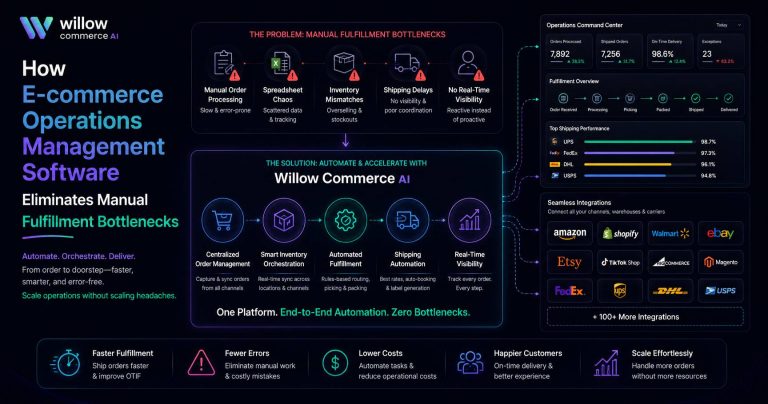
- How Willow Commerce, an omnichannel platform, streamlines listings, inventory, and order management
- How Willow helps businesses keep their listings consistent while effortlessly syncing inventory and orders
Why Do E-Commerce Companies Have Multiple SKUs for the Same Product?
When businesses sell on various marketplaces, they often encounter a range of SKU requirements that can be quite challenging:
- Marketplace-generated SKUs: Some platforms, such as Amazon, create their own ASINs or FNSKUs, which means sellers must track both their internal SKUs and those assigned by the marketplace.
- Channel-specific variations: eBay, for example, takes a different approach; it doesn’t require sellers to use SKUs. Instead, if a seller doesn’t provide one, eBay will automatically generate an Item ID, which is just a numeric identifier. This can lead to situations where the same product has a different SKU format on eBay compared to Shopify.
- Manual Listing: If sellers upload their products individually to each platform, they may inadvertently create duplicate SKUs.
All of this can result in inventory mismatches, overselling, and fulfillment errors, ultimately costing businesses both time and money.
The Challenge of Managing Duplicate SKUs
Without a centralized system, businesses face a number of challenges, including:
- Inventory Sync Issues: Stock levels may not update in real time across channels, leading to overselling.
- Order Management Complexity: Maintaining multiple SKUs for the same product can slow order processing and increase the risk of errors.
- Listing Inconsistencies: Product details such as titles, descriptions, and pricing can vary across platforms, undermining brand consistency.
- Manual Errors: Managing inventory and orders in Excel can be time-consuming and prone to human error.
How Willow Commerce Solves the Multiple SKU Problem
1. Centralizing Product Listings
- Single Source of Truth: Upload once, and Willow distributes to all marketplaces while maintaining a master SKU. It maps multiple channel SKUs of a single product to its Master SKU, thereby streamlining fulfillment.
- Inventory Accuracy: Whether a product has a seller-provided SKU or a marketplace-generated ID, Willow syncs stock levels in real time to prevent overselling.
- Inventory Accuracy: Whether a product has a seller-provided SKU or a marketplace-generated ID, Willow syncs stock levels in real time to prevent overselling or duplication errors.
2. Real-Time Inventory Synchronization
- Prevents Overselling: When an item sells on one channel, inventory updates instantly across all platforms.
- Bulk Adjustments: Update stock levels in Willow; changes reflect across the system.
3. Unified Order Management
- Aggregates Orders: All marketplace orders appear on a single dashboard, regardless of SKU differences.
- Automated Fulfillment: Syncs with shipping carriers (FedEx, UPS, etc.) to expedite order processing.
4. Consistent Listings with Variant Control
- Handles Product Variations: Manage color, size, and style variations without duplicate SKU chaos.
- Bulk Edits: Update pricing, descriptions, or images across all channels at once.
Why This Matters for E-Commerce Sellers
By using Willow Commerce, businesses can:-
- Reduce manual errors caused by mismatched SKUs.
- Save time by automating inventory and order workflows.
- Improve customer satisfaction by maintaining accurate stock levels and accelerating fulfillment.
- Scale efficiently as you add new sales channels.
Conclusion: Simplify Multi-Channel Selling with Willow Commerce
Managing multiple SKUs across various marketplaces can feel like a real headache, but it doesn’t have to be that way. Willow Commerce serves as a centralized hub, ensuring that even if different platforms assign their own SKUs, your internal operations remain smooth and efficient. With features such as real-time inventory synchronization, unified order management, and automated listing distribution, Willow empowers e-commerce businesses to sell more, stress less, and grow faster.
For e-commerce companies selling on multiple online marketplaces; think Amazon, eBay, Walmart, and Shopify, efficiently managing product listings is absolutely essential. However, when you list the same product across different platforms, it often results in duplicate or mismatched Stock Keeping Units (SKUs), creating issues in inventory and order management.
» Start Your Free Trial