

TL;DR
If you are evaluating Extensiv alternatives, Willow Commerce is the strongest overall pick for mid-market to enterprise multichannel sellers. It delivers unified order management, inventory sync, warehouse management, built-in shipping with carrier rate shopping and carrier-negotiated discounts, and AI-powered automation across every plan, with no feature gating, module fees, or contracts. For sellers tired of stitching together fragmented SaaS tools or paying escalating fees for features that should be standard, Willow Commerce offers the most complete operational foundation at a predictable cost.
Why Sellers Are Possibly Moving Away from Extensiv
Extensiv started as 3PL Central, a warehouse management platform built for third-party logistics providers. In 2021, the company acquired Skubana (renamed Extensiv Order Manager), Scout Software (renamed Extensiv Warehouse Manager), and CartRover (renamed Extensiv Integration Manager). The rebrand to Extensiv followed in May 2022. On paper, that sounds like a comprehensive suite. In practice, sellers have encountered a few recurring problems.
- Post-acquisition fragmentation. The acquired products were never fully unified into a single cloud-based platform. Users on Capterra report system glitches that worsened after the Skubana transition, and running Order Manager alongside Warehouse Manager causes performance conflicts. Each product has its own tech stack, with separate interfaces and data flows, creating sync friction that a natively built platform simply does not have.
- Escalating, layered pricing. Each product carries its own pricing tier. Order Manager runs $399 to $999+ per month, depending on order volume. Integration Manager adds another $39 to $199 per month for EDI and channel connectivity. The implementation fee alone reportedly costs around $7,000, and multiple reviewers describe it as non-refundable, even if the platform proves a poor fit. By the time you stack up Order Manager, Integration Manager, and implementation, you are well past what several alternatives charge for a complete, all-inclusive platform.
- Critical feature gaps. This is where the frustration gets specific:
- No built-in listing management. You cannot create, edit, or optimize product listings on any marketplace from within Extensiv.
- No native carrier rate shopping for shipping. Basic label generation is available, but multi-carrier comparison and negotiated rates are not.
- No returns management or reverse logistics. There is no native RMA workflow for processing returns, inspecting items, or restocking inventory.
- A 125,000 SKU cap that constrains larger catalogs, especially for sellers with heavy variation depth in apparel, electronics, or home goods.
- No support for kitting and bundling workflows within Order Manager.
- EDI connectivity requires a separate Integration Manager subscription rather than being included natively.
- Inventory accuracy issues. Overselling across channels is a consistent complaint. One reviewer documented fluctuating stock discrepancies across all SKUs, and support told them it was “normal.” Another reported that over 100 duplicate orders were pushed into their connected systems, creating significant stock-level mismatches. For multichannel sellers where inventory accuracy directly impacts seller metrics on Amazon and Walmart, this is a serious operational risk.
- Declining support quality. Reviewers on Trustpilot give the platform a 2.6 out of 5, describing lengthy response times, outsourced support that misreads initial tickets, and a tiered support model where non-premium customers struggle to get live assistance even for commerce-stopping issues. One SourceForge reviewer called it “possibly one of the worst support teams I have ever had the pleasure of speaking with.”
- No AI capabilities. In a market where AI-powered demand forecasting, dynamic pricing, and intelligent listing optimization are quickly becoming table stakes, Extensiv offers no meaningful AI functionality. For sellers looking to automate smarter (not just faster), this is a growing gap.
None of this means Extensiv is useless. It handles order routing well, integrates with major channels, and works for certain 3PL workflows. But for multichannel ecommerce sellers who need listing management, built-in shipping, real-time inventory sync across dozens of marketplaces, and AI-driven operations, there are better options available right now. Platforms like Cin7, Rithum (formerly ChannelAdvisor), and the five alternatives below all compete in this space, but these five represent the strongest options across different operational profiles.
How We Evaluated These Platforms
Before jumping into individual platforms, it helps to know what we measured. Every tool in this comparison was assessed against the same criteria, weighted toward what actually matters for multichannel ecommerce operations at scale, whether you are running a DTC brand, a B2B wholesale operation, or an omnichannel retail business selling across marketplaces and your own storefront.
- Multichannel listing management: Can the platform create, optimize, and manage product listings across marketplaces from a single interface? Does it support kitting, bundling, and variation management?
- Order management and routing: How effectively does it consolidate orders from all channels, automate fulfillment workflows, and push tracking information back to each marketplace? Does it handle both FBA and FBM, including Amazon Multi-Channel Fulfillment?
- Inventory management and sync: Does it provide real-time stock visibility across warehouses and channels, with automated reorder points, safety stock thresholds, and demand forecasting to prevent stockouts and dead stock?
- Warehouse management (WMS): Does the platform include native support for pick, pack, and ship workflows, barcode scanning, cycle counting, wave picking, and multi-warehouse support?
- Shipping and fulfillment: Is there built-in carrier rate shopping across parcel and LTL freight options, shipping label and packing slip generation, and shipping rule automation? Or does it require a third-party tool like ShipStation or Veeqo?
- Returns and reverse logistics: Can the platform handle RMA creation, returns processing, and restocking workflows?
- AI and automation capabilities: Does the platform use AI for demand forecasting, dynamic pricing, listing optimization, or intelligent order routing?
- Integrations: How many marketplaces, shopping carts, carriers, EDI partners, and accounting tools connect natively?
- Pricing transparency and total cost of ownership: Is the pricing publicly available, predictable, and free of hidden module charges or surprise increases?
- Ease of implementation and ongoing support: How long does onboarding take, what does it cost, and what happens when something breaks?
With those criteria in mind, let’s get into it.
#1. Willow Commerce – Best Overall Extensiv Alternative
Best for: Mid-market to enterprise multichannel sellers who want a unified, cloud-based SaaS operations platform with AI automation, built-in shipping, and predictable pricing.
Website: willowcommerce.ai
What It Is
Willow Commerce is a cloud-based multichannel ecommerce order management platform built for sellers who operate across Amazon, Walmart, Shopify, Shopify Plus, BigCommerce, eBay, Etsy, and dozens of other US-based marketplaces and regional channels. The company was founded in 2017 and is headquartered in Lyndhurst, New Jersey. It was previously known as GB Commerce before rebranding.
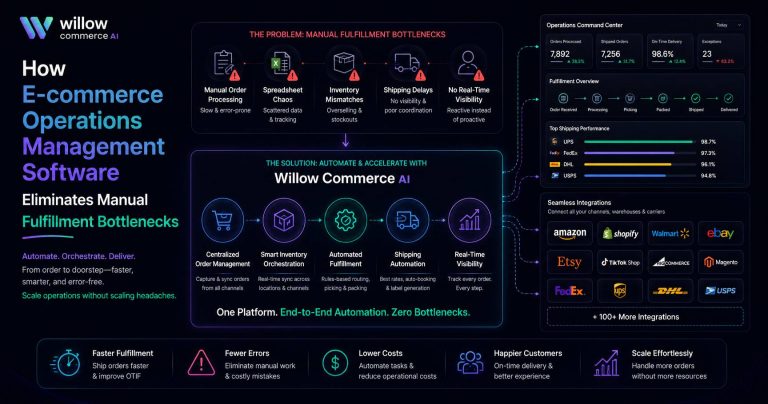
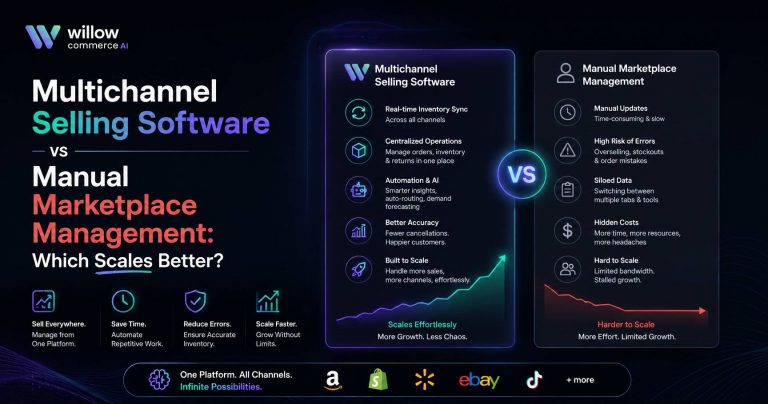
What makes Willow Commerce different from Extensiv at a structural level is that it was built as a single platform from day one. There is no Frankenstein assembly of acquired products with separate logins and inconsistent data flows. Everything, from catalog management to warehouse operations to shipping label generation, lives inside one system.
That distinction matters more than it sounds. When your inventory sync, order routing, and shipping tools are all genuinely connected (not just API-bridged between acquired products), the result is fewer sync errors, faster order processing, and less time troubleshooting why your Amazon Seller Central stock counts do not match your warehouse reality.
Listing Management
This is one of the clearest gaps in Extensiv, and one of the areas where Willow Commerce pulls ahead most visibly.
The platform provides centralized catalog management and AI-powered listing creation, tailoring product content to each marketplace’s specific requirements. You can manage bulk listing creation, channel-specific attributes, variation and configurable products, grouped products with tier pricing, and marketplace-aware sync logic that prevents accidental overwrites when pushing updates. Kitting and bundling are handled natively, so sellers can create product bundles, manage component inventory, and list kits across channels without third-party workarounds.
The platform also supports dropshipping workflows with partner management, allowing sellers to list products from suppliers without holding physical inventory and to maintain catalog consistency across all connected channels.
If you sell across 15 or 20 marketplaces, you already know how painful it is to manage listings manually or through separate tools for each channel. Willow Commerce consolidates all of that into a single interface.
Inventory Management and Demand Planning
Real-time inventory visibility across all channels and warehouses is the baseline here. The platform handles automated inventory sync, multi-warehouse tracking, strategic inventory allocation, safety stock thresholds, and low-stock alerts. The goal is straightforward: prevent stockouts that cost you sales and eliminate dead stock that ties up cash.
Where it gets more interesting is the AI layer. Willow Commerce uses AI-powered demand forecasting to predict future stock needs and automatically trigger replenishment before you run dry on a fast-moving SKU. Automatic reorder points and intelligent restocking algorithms keep stock levels optimized without requiring a team member to babysit spreadsheets every morning. Sales velocity data feeds directly into these algorithms, enabling the system to adapt as demand patterns shift across channels.
One client, Cymax Group Technologies, described the impact: “We’ve integrated Willow Commerce into our operational toolkit and have seen how its unified inventory and demand planning features genuinely reduce stockouts and minimize excess.”
Order Management
Orders from every connected marketplace flow into a single dashboard. From there, automated processing kicks in: order import, fulfillment routing to the nearest warehouse, tracking number push-back to the marketplace, and customizable order rules that let you set logic for how different order types get handled.
The platform supports both FBA and FBM fulfillment, including Amazon Multi-Channel Fulfillment, enabling sellers to route non-Amazon orders through Amazon’s warehouse network. It connects to both Amazon Seller Central and Amazon Vendor Central, covering the full spectrum of Amazon selling models. Automated email rules and a configurable Order Rule Engine give you granular control over the fulfillment workflow without requiring custom development.
Built-In Shipping (A Major Differentiator)
This is where many Extensiv users feel the pain most acutely, because Extensiv simply does not offer built-in carrier rate shopping or comprehensive shipping management.
Willow Commerce includes a built-in multi-carrier rate comparison tool with discounted carrier rates. The founding team includes former UPS and FedEx executives, which means the company offers pre-negotiated rates that it claims save sellers 10-15% compared with tools like ShipStation or Veeqo. Supported carriers include UPS, FedEx, USPS, DHL, Amazon Shipping, and LTL freight carriers for heavier shipments.

The platform also automates shipping label creation, shipping rule assignment, packing slip generation, and includes a ShipBridge desktop app for warehouse label printing. For sellers managing shipping budgets anywhere from $50,000 to $100 million annually, having all of this inside the same platform that handles your orders and inventory eliminates a significant integration headache. No middleware, no Zapier workarounds, no praying that your third-party shipping tool stays in sync with your order management system.
Warehouse Management
Willow Commerce includes built-in WMS capabilities with real-time warehouse inventory tracking, automated pick, pack, and ship workflows, barcode scanning, warehouse visualization with racking inventory views, picking area inventory management, and support for multiple warehouses and distribution centers. Cycle counting is supported natively, and the system tracks inventory movement at the bin level across facilities.
One enterprise client, Zuay LLC, put it this way: “I manage all our 33 marketplaces with [Willow Commerce], inventory, tracking numbers, orders, warehouse visualization, racking inventory, picking area inventory, and main product catalog.”
Returns and Reverse Logistics
Unlike Extensiv, which has no native RMA or returns management, Willow Commerce supports returns-processing workflows that cover the full reverse-logistics cycle. Returned items can be inspected, restocked, or dispositioned within the same system that manages forward fulfillment, keeping inventory counts accurate in real time.
AI Capabilities
Rather than treating AI as a marketing checkbox, Willow Commerce embeds it across multiple operational layers:
- Dynamic pricing that adjusts based on real-time demand and market conditions to protect profit margins
- Predictive demand forecasting for inventory optimization, reducing both stockouts and dead stock
- AI-powered listing creation tailored to each marketplace’s requirements
- Intelligent restocking algorithms that maintain optimal safety stock levels
- AI-driven shipping engine for automatic carrier rate shopping and optimization
- Personalized product recommendations based on purchase behavior
- Actionable KPI dashboards that surface data-backed decisions for pricing, promotions, and inventory, including sales velocity, COGS analysis, and channel performance tracking
A Shopify App Store reviewer noted: “With the growing AI functionality being added almost daily, don’t think about switching, do it!”
Integrations
Willow Commerce connects with 80 to 150+ marketplace integrations across categories:
- Major US marketplaces: Amazon (Seller Central and Vendor Central, multiple regions), Walmart, Walmart DSV, eBay, Etsy, Wayfair, Target, Best Buy, Macy’s, Kohl’s, Nordstrom, Home Depot, Faire, TikTok Shop, Newegg
- Additional channels: Mirakl-powered marketplaces, Reebelo, Back Market, Overstock, Wish, Groupon, Google Shopping, Facebook Marketplace
- Shopping carts: Shopify, Shopify Plus, BigCommerce, Magento/Adobe Commerce (1 & 2), WooCommerce, Spree Commerce
- Carriers: UPS, FedEx, USPS, DHL, Amazon Shipping, LTL freight carriers
- Social commerce: Instagram, TikTok Shop, Facebook
- EDI connectivity is supported for B2B wholesale accounts and retail partners that require electronic data interchange for purchase orders and invoicing.
Pricing
This is where Willow Commerce makes the sharpest break from Extensiv.
Every plan includes every feature. No feature tiers, no module upsells, no per-channel charges. Pricing scales based on monthly order volume only. Here is how it breaks down:
| Plan / Monthly order volume | Price / Month | What’s Included |
| Starter Under 2,000 orders | $499 | All features, unlimited stores, users, integrations, products |
| Growth 2,000 – 4,999 orders | $999 | |
| Pro 5,000 – 9,999 orders | $1,999 | |
| Enterprise 10,000+ orders | Custom pricing | |
| Implementation fee | Included | Dedicated onboarding team |
| Contracts | None | Month-to-month, cancel anytime |
| Free trial | 14 days | Full access |
Notice the “What’s Included” column. It is the same across every row. That is the point. There is no starter plan with half the features and no enterprise tier that finally unlocks the tools you actually need. You get the full platform from day one.
Compare that to Extensiv, where you might pay $999 per month for Order Manager, another $99 to $199 per month for Integration Manager, $7,000 upfront for implementation, and still not have listing management or shipping.
Where Willow Commerce Falls Short
No platform is perfect. There is no dedicated mobile app as of early 2026. Because the Willow Commerce brand is relatively new (rebranded from GB Commerce), it does not yet have the market awareness of Extensiv, Sellercloud, or Linnworks. None of those are dealbreakers, but they are worth knowing.
Review Scores
- G2: 5/5
- Capterra: 4.6/5
- Software Finder: 4.8/5
- GetApp: 4.6/5

#2. Descartes Sellercloud – Best for Complex, High-Volume Operations
Best for: Technically sophisticated sellers with large catalogs, complex workflows, and the internal resources to handle a steep learning curve.
Website: sellercloud.com
Sellercloud has been around since 2010 and was acquired by Descartes Systems Group in October 2024 for approximately $110 million. It is now branded as Descartes Sellercloud.
In terms of raw feature depth, Sellercloud is arguably the most comprehensive legacy platform on this list. It includes catalog and listing management, inventory management, a full WMS called Skustack (with barcode scanning, cycle counting, and bin-level tracking), order management with a customizable rule engine, purchasing, a free shipping tool called Shipbridge (with multi-carrier label generation and packing slip printing), reporting, accounting, and over 350 integrations with no per-channel fees. The platform serves 1,000+ merchants managing over $15 billion in annual order value.
Customization is where Sellercloud really flexes. You can build custom plug-ins, write scripts, configure the Rule Engine for complex automation, and access thousands of RESTful API endpoints. EDI connectivity is built in for B2B wholesale and retail partners. If your operation has DTC, wholesale, and marketplace channels with workflows that do not fit neatly into standard software, Sellercloud provides the tools to make them work.
The integration library is the largest in this comparison, with 350+ integrations, covering Amazon Seller Central, Amazon Vendor Central, Shopify, Shopify Plus, Walmart, eBay, Etsy, Wayfair, TikTok Shop, Target, Newegg, Google Shopping, and dozens more.
The Trade-Offs
All of that power comes with real costs.
The learning curve is steep. Reviewers on Capterra describe it as “not for the faint of heart,” and the platform currently runs two separate UI versions (Alpha and Delta) that can cause navigation confusion. Implementation can take up to three months for complex setups. The minimum monthly cost is $1,000, with a per-order fee of approximately $0.15 that applies as volume increases, plus $2,000 to $3,500 for implementation.
There is no native AI for demand forecasting, dynamic pricing, or listing optimization beyond predictive purchasing. The Amazon listings module was reportedly still not fully functional as of mid-2025. And while Sellercloud offers more integrations than any other platform in this comparison, it requires a technically skilled team to configure and maintain it. Returns management exists but is less streamlined than the forward fulfillment workflow.
If you have that team and need that level of configurability, Sellercloud is hard to beat. If you want a cloud-based SaaS platform that works out of the box without a three-month ramp-up period, look elsewhere.
Pricing
| Component | Cost |
| Monthly minimum | $1,000/month |
| Per-order fee | ~$0.15/transaction above minimum |
| Implementation | $2,000 to $3,500 |
| Premium support (optional) | $500/month |
| Contracts | None required |
Review Scores
#3. Linnworks – Best for Rules-Based Automation (If You Can Stomach the Price Increases)
Best for: Sellers who prioritize automated order processing rules and real-time inventory sync across multiple warehouses, and who want WMS capabilities via SkuVault Core.
Website: linnworks.com
Linnworks is a UK-based cloud platform founded in 2002 and now majority-owned by Marlin Equity Partners. The company acquired SkuVault in September 2022 to combine Linnworks’ order and inventory management with SkuVault’s warehouse management capabilities. The platform processes over $8 billion in annual gross merchandise value.
The Rules Engine is the standout feature. You can create unlimited automation rules for order sorting, prioritization, routing, carrier assignment, and batch processing. For sellers with complex fulfillment logic, this is genuinely useful. One client reported that their real-time inventory sync reduced lost inventory from 7-8% to 1%, directly cutting overselling incidents across channels.
Linnworks also offers multichannel listings, but these are available only on select channels (Amazon, eBay, Shopify) and not across the full integration library. The SkuVault Core WMS provides bin-level tracking, barcode scanning, quality control workflows, digital picklists, and cycle counting. Shipping integrations connect to major carriers to print labels and track deliveries.
The integration count is approximately 100+ channels, including Amazon, eBay, Walmart, Shopify, TikTok Shop, and OnBuy. That is significantly fewer than Sellercloud’s 350+ or Willow Commerce’s 80-150+. Regional US channels, Newegg, Overstock, Google Shopping, and several niche marketplaces are either missing or require workarounds.
The Elephant in the Room: Pricing
Here is where things get uncomfortable. Linnworks does not publish pricing publicly, and multiple reviewers on G2 and Capterra describe aggressive, unpredictable price increases since the Marlin Equity acquisition. The numbers cited are jarring: one user reported costs jumping from £6,000 to £22,000 per year with only 30 days’ notice. Another described an increase from £1,800 to £52,000.
This is the single most common complaint in recent Linnworks reviews, and it is a legitimate risk factor for any business evaluating the platform. Predictable cost of ownership is not available here.
Beyond pricing, customization is limited compared to Sellercloud or Willow Commerce. The two product lines (Linnworks Advanced and SkuVault Core) remain somewhat separate systems that have not been fully unified. There is no native returns management or reverse logistics workflow, and kitting and bundling capabilities are basic. The lack of a dedicated mobile app for warehouse operations rounds out the shortcomings.
Pricing
| Component | Details |
| Starting price | ~$449/month (estimated) |
| Model | Order-volume tiers, quote-based |
| Free trial | 14 days |
| SkuVault Core | Separate quote-based pricing |
| Price increase risk | High (well-documented) |
Review Scores
- G2: Generally positive for core functionality
- Capterra: 4.1/5 (increasingly critical in recent reviews)
- SelectHub: 86% satisfaction
#4. Brightpearl (Sage) – Best for Retail and Wholesale Operations Needing Built-In Accounting
Best for: Retailers and wholesalers trading $1M+ annually who need integrated ERP accounting, CRM, and POS capabilities alongside order management.
Website: brightpearl.com
Brightpearl was acquired by Sage for $299 million in January 2022 and rebranded as Brightpearl by Sage. It positions itself as a “retail operations platform” rather than a pure ecommerce tool, and that distinction tells you a lot about who it is built for.
The strongest argument for Brightpearl is the built-in accounting module. Real-time financials, general ledger, accounts payable and receivable, bank reconciliation, profit margin tracking, COGS reporting, and P&L reporting are all native to the platform. If you are currently running your ecommerce financials in a separate accounting tool and want to eliminate that integration, Brightpearl can do that. It also integrates with Sage Intacct, QuickBooks, and Xero for businesses that want to keep their existing accounting stack.
The Automation Engine is well-regarded. It handles rule-based workflows for fulfillment, shipping, invoicing, and warehouse routing. Brightpearl claims it saves users two months per year and reduces errors by 65%. It also includes CRM capabilities with customer profiles, order history, and Klaviyo integration for marketing segmentation. For businesses that blend DTC ecommerce, B2B wholesale, and physical retail through POS systems like Lightspeed or Square, Brightpearl’s omnichannel retail approach covers all three.
The Problems Are Significant
Let’s be direct about the limitations, because they are substantial for multichannel ecommerce sellers.
Brightpearl has no built-in shipping features. No carrier rate shopping, no shipping label generation, no carrier management. You need a third-party add-on such as ShipStation, ShipTheory, or ParcelHub. There is no native last-mile delivery optimization or LTL freight support.
It has no listing management. You cannot create or manage marketplace listings from within Brightpearl. One Capterra reviewer noted that “It couldn’t link directly to any of the Amazon websites, nor to Shopify or anywhere else.”
And the integration library is the smallest in this comparison. Brightpearl offers roughly 20 to 30 Plug-and-Play integrations, plus an open API. Native marketplace connections are limited to Amazon, eBay, Walmart, and OnBuy. There is no native integration with Etsy, TikTok Shop, Wayfair, Target+, Faire, Newegg, or Google Shopping. No EDI support is built into the system for B2B wholesale partners. One reviewer stated that “Brightpearl hasn’t added a single marketplace integration in 6 years.” Social commerce channels like Instagram and Facebook Marketplace are absent.
Pricing is custom and not publicly disclosed, but realistic mid-market costs range from $15,000 to $40,000+ per year. Multiple reviewers report that leaving the platform is expensive, with one user quoted £10,080 for read-only access after cancellation.
If your business model blends physical retail, wholesale, and ecommerce, and you have a strong need for built-in financials, and you primarily sell through Shopify Plus and Amazon, Brightpearl makes sense. For pure multichannel ecommerce sellers who need broad marketplace coverage, the missing features are hard to overlook.
Pricing
| Component | Estimate |
| Annual cost range | $15,000 to $40,000+/year |
| Users | Unlimited, included |
| Implementation | Expert-led, included (approx. 120 days) |
| Contracts | Annual |
Review Scores
- G2: 4.5/5
- Capterra: 4.4/5
- Trustpilot: Mixed (concerns about Sage investment and feature stagnation)
#5. NetSuite (Oracle) – Best for Enterprises Already Committed to Oracle’s Ecosystem
Best for: Large enterprises that need a full ERP with financials, HR, supply chain, and ecommerce capabilities in a single system, and have the budget and timeline to support it.
Website: netsuite.com
Let’s be upfront. NetSuite is not really an Extensiv alternative, unlike the other four platforms on this list. It is a full enterprise ERP serving 41,000+ customers in 200+ countries. But it comes up in every “Extensiv alternatives” search, so it is worth addressing honestly.
For multichannel ecommerce, the relevant NetSuite modules include the base ERP (financials and accounting), SuiteCommerce (ecommerce storefront), Order Management, Inventory Management, and WMS. Each is priced as a separate add-on module, which quickly makes the cost picture challenging.
The Cost Reality
There is no way to sugarcoat this. NetSuite is expensive.
The base platform starts at $999 to $1,000 per month for a Starter Edition (up to 10 users). Per-user licenses run $99 to $149 per month per named user. SuiteCommerce adds $2,000 to $5,000 per month. The WMS module costs $599 to $1,999 per month. Implementation fees range from $10,000 to $150,000 or more, with some global deployments exceeding $500,000. There is also a 3-7% annual price increase built into every contract.
Year-one total cost of ownership for a mid-market ecommerce operation typically ranges from $75,000 to $200,000+. Ongoing annual costs run $40,000 to $150,000+. You are paying per named user, not unlimited users, so every warehouse associate or customer service rep who needs access counts toward the bill.
Why It Falls Short for Multichannel Sellers
The native NetSuite Connector supports only 12 platforms: Shopify, BigCommerce, Adobe Commerce, WooCommerce, Amazon Seller Central, Amazon Vendor Central, eBay, Walmart, Salesforce, ShipStation, Amazon MCF, and Oracle Symphony POS. That means no native TikTok Shop, Etsy, Wayfair, Target+, Faire, Best Buy, Home Depot, Newegg, Google Shopping, or any regional channels.
To connect those marketplaces, you need third-party middleware such as Celigo or ChannelEngine, at an additional cost of $300 to $4,000+ per month. Reviewers report that these connectors frequently fail in complex workflows, resulting in inventory discrepancies and overselling across channels. No native EDI support for marketplace or retail partner integration adds further middleware dependency.
Implementation takes 3 to 12+ months, depending on complexity, and customization (while extensive through SuiteScript) requires specialized NetSuite developers at $150 to $350 per hour. Data migration alone can run $5,000 to $25,000+. The platform meets SOC 2 and PCI compliance requirements, which matters for enterprise security teams, but that does not offset the operational complexity for most ecommerce sellers.
If you are a large enterprise already running Oracle products and need a unified ERP that also supports ecommerce, NetSuite is a good fit. If you are a multichannel ecommerce seller looking for a focused SaaS operations platform, NetSuite is an extremely expensive way to get capabilities that purpose-built tools deliver more efficiently.
Pricing
| Component | Cost Range |
| Base platform | $999 to $5,000/month |
| Per-user license | $99 to $149/user/month |
| SuiteCommerce | $2,000 to $5,000/month |
| WMS module | $599 to $1,999/month |
| Implementation | $10,000 to $150,000+ |
| Year 1 total | $75,000 to $200,000+ |
Review Scores
- G2: 4.0/5
- Capterra: 4.2/5
- Most common G2 feedback themes: “Learning Curve,” “Improvement Needed,” “Not User-Friendly.”
Side-by-Side Comparison
| Feature | Willow Commerce | Sellercloud | Linnworks | Brightpearl | NetSuite |
| Starting price | ~$499/mo | $1,000/mo min | ~$449/mo | ~$15K-$40K/yr | $75K-$200K+ yr 1 |
| Pricing model | All-inclusive, volume-based | Per-order after minimum | Volume tiers, quote | Custom, volume-based | Per-user + modules |
| Implementation fee | Included | $2,000-$3,500 | Quote-based | Included | $10K-$150K+ |
| Listing management | Yes, AI-powered | Yes, comprehensive | Select channels only | No | No |
| Built-in shipping | Yes, with carrier rate shopping | Yes (Shipbridge) | Yes, basic | No (third-party needed) | No (third-party needed) |
| WMS (pick, pack, ship) | Yes, built-in | Yes (Skustack) | Yes (SkuVault Core) | Basic | Add-on module |
| Returns / reverse logistics | Yes | Yes | No native workflow | Basic | Add-on |
| AI capabilities | Yes, 8+ features | Predictive purchasing only | AI-assisted orders | No | Basic |
| Kitting and bundling | Yes, native | Yes | Basic | Yes | Yes |
| Integrations | 80-150+ | 350+ | 100+ | 20-30+ | 12 native |
| EDI support | Yes | Yes | Limited | No | Via middleware |
| Built-in accounting | Yes | QuickBooks integration | QuickBooks/Xero integration | Yes, full ERP | Yes, full ERP |
| Dropshipping support | Yes | Yes | Limited | No | Via customization |
| Contracts required | No | No | Varies | Annual | Annual |
| Users included | Unlimited | Unlimited | Varies by tier | Unlimited | Per-user licensed |
| SKU limits | None stated | None stated | Not stated | Not stated | None |
| Review scores | 4.6-4.8/5 | 4.4/5 | 4.1/5 (recent) | 4.4-4.5/5 | 4.0-4.2/5 |
Final Verdict
Each platform on this list serves a different operational profile, and the right choice depends on where your business stands today and where you plan to take it over the next two to three years.
Choose Sellercloud if you have a technically skilled operations team, need 350+ integrations, and are willing to invest in a complex setup for maximum configurability. It handles DTC, B2B wholesale, and marketplace channels with deep customization options, but demands that the team match.
Choose Linnworks if rules-based automation and real-time inventory sync are your primary concerns, and you are comfortable with the pricing uncertainty that comes with PE ownership. Just budget for the possibility that your costs could double or triple without much warning.
Choose Brightpearl if you blend physical retail, wholesale, and ecommerce and need built-in accounting with real-time COGS and profit margin reporting in a single omnichannel retail system. Accept that you will need third-party tools for shipping and listing management.
Choose NetSuite if you are an enterprise already operating in Oracle’s ecosystem and need a full ERP that integrates with ecommerce as part of a broader business system. Understand that you are paying enterprise ERP prices and implementation timelines for capabilities that purpose-built SaaS platforms deliver at a fraction of the cost.
Choose Willow Commerce if you want the most complete multichannel operations platform without fragmentation, module fees, or a three-month implementation timeline. It is the only platform in this comparison that delivers AI-powered listing management, built-in carrier rate shopping with negotiated shipping discounts, real-time warehouse management with pick, pack, and ship workflows, returns and reverse logistics, dropshipping support, and unified order and inventory management across every plan at a predictable monthly cost.
For most US-based multichannel sellers evaluating Extensiv alternatives in 2026, Willow Commerce represents the most straightforward path to operational control without long-term lock-in.
The decision ultimately comes down to operational maturity and your platform requirements. If you want a quick fix for a narrow problem, there are lighter tools, such as Ordoro or Zoho Inventory, that might fit the bill. But if you want long-term control over your multichannel operations, with room to grow and a cloud-based platform that scales with you, Willow Commerce is the place to start.
Switching from Extensiv: What to Expect
If you are currently on Extensiv and considering a move, here is a realistic view of the migration process.
Timeline. Most sellers complete a full platform switch in 2 to 6 weeks, depending on catalog size, number of connected channels, and warehouse complexity. Willow Commerce and Sellercloud both offer dedicated onboarding teams that handle much of the heavy lifting. Linnworks and Brightpearl typically take longer; Brightpearl quotes approximately 120 days for full implementation. NetSuite is in a different category entirely, with an average of 4-12 months.
Data migration. The core data you need to move includes your product catalog (SKUs, titles, descriptions, images, variations), historical order data, current inventory counts, customer records, and warehouse configurations. Most platforms accept CSV imports for catalog and inventory data. If you are running Extensiv’s Integration Manager for EDI connections, verify that your new platform supports the same EDI partners before cutting over.
Parallel running. The safest approach is to run both systems simultaneously for one to two weeks. Process orders on both platforms until you trust the new system’s inventory sync, order routing, and push-back tracking accuracy. This overlap period catches sync issues before they become customer-facing problems, such as overselling or missed shipments.
Switching costs to consider. Extensiv’s implementation fee is widely reported as non-refundable. Check your contract terms for any early termination penalties or minimum commitment periods. Factor in the time your team will spend on training and configuration in the new platform, even if the software itself offers free onboarding.
Marketplace reconnection. Each marketplace API connection (Amazon Seller Central, Walmart, Shopify, eBay, etc.) will need to be re-authenticated in the new platform. This is straightforward but takes time. Plan for a day of channel reconnection and a day of testing before going live.
The most important thing: do not rush the cutover. A well-planned migration takes slightly longer but avoids the inventory discrepancies and fulfillment errors that damage seller metrics on Amazon and Walmart.
Frequently Asked Questions
No. Extensiv Order Manager can generate basic shipping labels, but does not offer carrier rate shopping, multi-carrier comparison, or negotiated shipping discounts. Most sellers pair it with a separate tool, such as ShipStation.
No. Extensiv cannot create or manage listings. You cannot create, edit, or optimize product listings on Amazon, Walmart, eBay, or any other marketplace from within the platform.
Among the platforms in this comparison, Linnworks (starting around $449/month) and Willow Commerce ($499/month) have the lowest entry points. For sellers with smaller operations or tighter budgets, lighter tools such as Ordoro or Zoho Inventory offer more affordable starter tiers, though with significantly fewer features.
Extensiv’s pricing starts at $399/month for Order Manager alone, with a roughly $7,000 implementation fee. For small businesses processing fewer than 1,000 orders per month, the total cost of ownership is high relative to the feature set. Platforms like Willow Commerce offer greater value at lower-volume levels.
Willow Commerce and Sellercloud both offer deep Amazon integration covering Seller Central, Vendor Central, FBA, FBM, Multi-Channel Fulfillment, and Amazon Shipping. Willow Commerce adds AI-powered listing creation specifically tailored for Amazon’s catalog requirements.
Willow Commerce, Sellercloud, and Linnworks all support Walmart Marketplace natively. Willow Commerce also connects to Walmart DSV (Drop Ship Vendor) for sellers operating in Walmart’s first-party fulfillment model.
Apparel sellers typically need strong variation management (size, color, material), kitting for gift sets, and support for a high SKU count. Willow Commerce and Sellercloud handle these requirements natively. Brightpearl also works well for apparel brands that blend DTC ecommerce with wholesale and physical retail.
Health and beauty sellers need lot tracking, expiration date management, and compliance-aware catalog management. Electronics sellers need serial number tracking and robust returns workflows. Sellercloud offers the deepest capabilities, while Willow Commerce covers the core requirements for most mid-market operations.
Most migrations take 2 to 6 weeks for mid-market sellers, including data migration, channel reconnection, testing, and team training. Running both systems in parallel for 1 to 2 weeks before full cutover is strongly recommended.
Yes. Willow Commerce, Sellercloud, and Brightpearl all support hybrid B2B wholesale and DTC ecommerce operations. Willow Commerce and Sellercloud include EDI connectivity for wholesale partners. Brightpearl adds POS integration for businesses with physical retail locations.
For most mid-market to enterprise US-based sellers, Willow Commerce offers the strongest combination of feature completeness, AI automation, built-in shipping, and predictable pricing. Sellercloud is the best option for highly complex operations that need maximum configurability. The right choice depends on your operational maturity and channel mix.
Let Willow Commerce simplify your inventory and shipping management today.
» Start Your Free Trial
Disclaimer: The information in this article is based on publicly available data, user reviews on platforms like G2, Capterra, and Trustpilot, and third-party public research sources as of early 2026. Product features, pricing, and capabilities change over time. We encourage readers to verify details directly with each vendor before making a purchasing decision.