
How long can you keep adding marketplaces before the process starts cracking? Manual control feels efficient because you can review listings, change prices, and track orders. Then volume climbs. A few channels become many. A few hundred SKUs become thousands. The work turns reactive.
That shift appears when growth outpaces the operating structure. Spreadsheets drift away from marketplace dashboards. Inventory updates lag. Listing changes stay incomplete. Support teams chase order issues that started in the back end. At that point, multichannel selling software stops sounding optional and starts looking like core infrastructure. If you want scale, you need control over catalog data, stock movement, order routing, promotions, and reporting.
Why Multichannel Selling Software Changes the Scaling Equation

Manual marketplace management can support a small catalog and limited order flow. It struggles when a business adds more channels, warehouses, brands, and promotional cycles. The question changes fast. It becomes whether the model can support growth without piling on labor, delays, and mistakes.
Managing High SKU Volumes Without Slowing Down Operations
Large catalogs create hidden friction. Product titles vary by marketplace. Attribute rules shift by channel. Parent-child relationships need consistency. Images, bullets, compliance fields, and tax categories require constant review. When teams manage that workload by hand, every update touches too many people.
With multichannel selling software, teams can manage listing logic centrally, map product data once, and publish faster with fewer duplicate tasks. That makes a difference when a seller carries bundles, variants, seasonal assortments, and channel-specific content rules.
Keeping Inventory Aligned Across Multiple Sales Channels
Inventory problems often begin with lag. One marketplace sells faster than expected, another channel updates late, and a warehouse count changes after a return or damaged unit. Now that the business has sold stock, it cannot ship.
Research shows 66% of consumers use two or more sales channels before they complete a purchase. That behavior raises the need for synchronized inventory and clean order visibility. In practice, multichannel selling software reduces those gaps by syncing stock levels across connected channels instead of forcing staff to reconcile numbers manually.
Handling Order Flow Without Delays or Missed Fulfillment
Order complexity rises faster than most teams expect. Each channel has its own service levels, shipping rules, cancellation windows, and notification requirements. Manual workflows create queues, and queues create missed cutoffs.
A centralized workflow changes execution speed. Orders enter one stream, staff can route them faster, and fulfillment logic becomes easier to manage across internal operations, 3PLs, and marketplace programs. Teams also spend less time checking whether labels were created, tracking numbers were pushed, or exceptions were caught.
Reducing Listing Errors Across Marketplaces
Manual listing work creates a quiet tax on growth. One channel shows an outdated image. Another carries an old size chart. A third still shows retired copy or incorrect dimensions. Those errors weaken conversion and raise return risk.
Centralized listing control protects marketplace health and keeps brand presentation tighter. Teams can move faster during launches, assortment shifts, and product updates without rewriting the same data in multiple places.
Managing Pricing, Discounts, and Promotions Across Platforms
Pricing breaks down when sellers treat every marketplace as a separate island. Teams forget to update a coupon, miss a bundle adjustment, or change a base price on one channel but not another. Margin starts leaking before leadership notices.
This is another point where multichannel selling software changes the economics. Central rules help sellers update prices, schedule promotions, and keep marketplace parity without constant manual review. That becomes critical during holiday campaigns, vendor-funded offers, and flash sales.
Tracking Performance and Sales Data From One Place
Manual reporting looks simple until leadership wants answers across channels, warehouses, and product groups. Then teams export files, clean reports, merge tabs, and hope the numbers match.
Industry research has shown that unified commerce leaders grow 2 times faster than retailers operating with basic commerce maturity. Better visibility into inventory, orders, channel performance, and customer behavior supports better decisions. It also reduces the cost of reacting late.
How Willow Commerce Supports Scalable Marketplace Operations
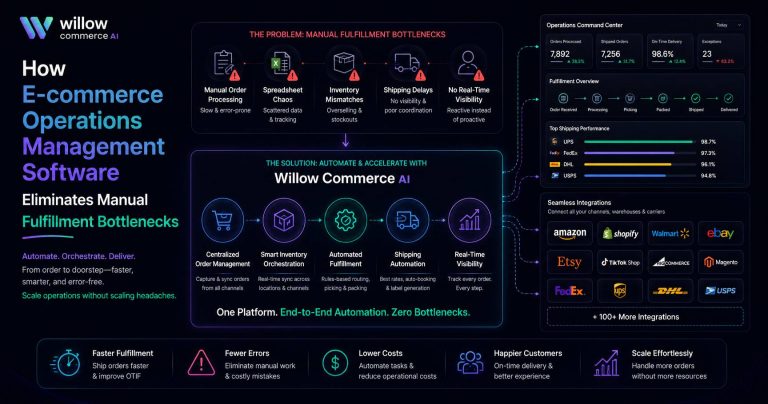
Willow Commerce treats channel management as an operating layer, not a connector page. Its Channels module acts as the control point for listings, inventory, pricing, and orders across marketplaces, helping sellers avoid the split between channel growth and operational stability. We built that layer to keep core commerce actions connected rather than scattered across separate tools.
That structure shows up in the platform:
- one dashboard for channels, catalog, orders, inventory, shipping, warehouse workflows, analytics, B2B operations, and 3PL fulfillment
- support for 70-plus marketplaces and commerce channels, including Amazon, Walmart, Shopify, Etsy, TikTok Shop, Target, Wayfair, and eBay
- automation for order import, stock sync, label creation, tracking updates, and carrier comparison
We also bring warehouse actions, multi-warehouse support, and FBA-related workflows into the same environment. For brands replacing ShipStation, Linnworks, Sellercloud, and spreadsheet-heavy processes, that consolidation reduces operational drift without adding another admin layer.
Key Differences That Impact Long-Term Growth
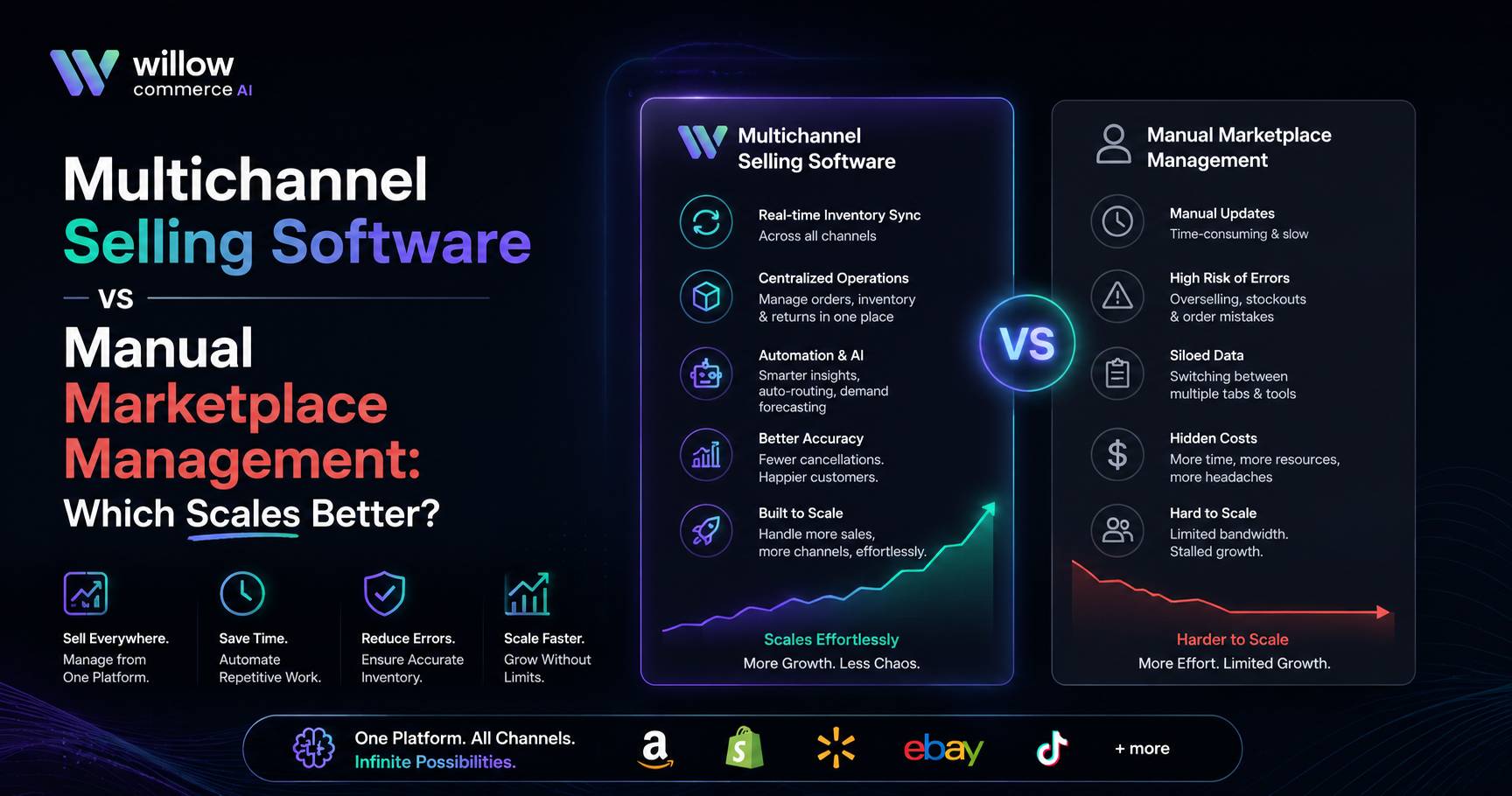
The real comparison is not software versus labor. It is fragmented execution versus controlled scale.
| Area | Manual marketplace management | Structured platform approach |
| Catalog updates | Repeated edits by the channel | Central publishing logic |
| Inventory control | Delayed reconciliation | Near real-time sync |
| Order handling | More handoffs and exceptions | Unified processing flow |
| Promotion control | Inconsistent changes | Shared pricing rules |
| Reporting | Export, merge, verify | One operational view |
| Expansion | Each new channel adds drag | New channels fit existing workflows |
Manual management can work for a small seller with a narrow assortment and low order volume. Past that point, the model starts consuming time that should go into merchandising, retention, and expansion.
Conclusion
The better option depends on the business you plan to become, not only the business you operate today. If you expect more channels, larger catalogs, faster order volume, and tighter fulfillment targets, manual management will start pulling resources away from growth.
That is why many growing sellers move toward multichannel selling software when they want cleaner execution, tighter stock control, and less operational waste. If you are ready to scale with fewer manual gaps and more control, we can help map the right next step.
FAQs
What is the highest hidden cost of manual marketplace management?
It usually shows up in wasted staff hours, duplicate edits, stock mismatches, and small mistakes that pile up fast.
Can smaller brands justify a platform before they reach enterprise size?
Yes, especially once a brand starts selling on several channels and the daily work stops feeling manageable.
How long does channel onboarding usually take in a centralized system?
That depends on your catalog, channel rules, and setup quality, but clean data almost always shortens the process.
Does one platform help with returns and post-purchase issues too?
Yes, because better order visibility helps teams catch issues early and sort returns with less back and forth.
What should operators test before choosing a platform?
Check how it handles listings, inventory, order routing, reports, warehouse tasks, and whether your team can use it.