
TikTok Shop is no longer a side experiment. U.S. sales on the platform grew 120% year-over-year through the first half of 2025, the product catalog now spans over 750 categories and 70 million products, and eMarketer projects that 51% of U.S. social buyers will purchase on TikTok in 2026. Social commerce in the U.S. is on track to cross $100 billion this year.
Those numbers explain why every multichannel seller is at least considering TikTok Shop. But here’s what most of them don’t realize until they’re already live: TikTok Shop operates under a fundamentally different logistics framework than Amazon, Walmart, or any traditional marketplace. The fulfillment requirements are stricter in some ways, stranger in others, and they’ve been changing rapidly throughout early 2026.
If you’re already selling on Amazon and Walmart, you might assume TikTok Shop is just another channel to plug into your existing workflow. That assumption will cost you. Let’s walk through what TikTok actually requires, how it compares to the marketplaces you already know, and why Willow Commerce is built for this exact situation.
TikTok Shop’s Fulfillment Requirements: What Changed in 2026
TikTok rewrote the fulfillment rulebook in early 2026, and the changes caught many sellers off guard.
The headline shift: TikTok moved aggressively toward platform-controlled shipping. Traditional “seller shipping,” where you pick your own carrier, generate your own labels, and ship however you want, was originally slated for elimination by March 31, 2026. TikTok paused that mandate in February, but the direction is clear. The platform wants sellers operating within its logistics ecosystem, not around it.
As of mid-2026, sellers have three primary fulfillment paths:
- Fulfilled by TikTok (FBT): You send inventory to TikTok’s warehouses. TikTok handles storage, picking, packing, shipping, and returns. Think of it as TikTok’s answer to Amazon FBA. The upside is zero fulfillment headaches. The downside is you lose control over branded packaging, inventory access, and margin visibility.
- TikTok Shipping (Upgraded): You fulfill from your own warehouse or 3PL, but you must use TikTok’s approved carrier network and generate labels through TikTok’s shipping system. This is the middle ground. You retain operational control while working within TikTok’s logistics framework.
- Collections by TikTok (CBT): TikTok manages the carrier pickup and delivery logistics from your facility. You prepare the order; TikTok handles the last mile.
A critical detail that trips up sellers transitioning from Amazon or eBay: as of January 2026, all USPS labels for TikTok Shop orders must be purchased through TikTok Shipping. You can’t generate USPS labels in an external platform and sync them back. Non-USPS carriers (UPS, FedEx, DHL) can still use seller-generated labels, but USPS, which a huge portion of ecommerce sellers rely on for lightweight parcels, is locked to TikTok’s system.
The SLAs That Actually Matter
TikTok’s dispatch requirements tightened significantly on January 26, 2026. The core SLAs every seller must hit:
- Dispatch SLA: Orders must be dispatched within 2 business days of entering “Awaiting Shipment” status, with a cutoff of 11:59 PM PST
- Delivery SLA: Standard and economy orders must be delivered within 6 business days; express orders within 3 business days
- Auto-cancellation: Orders not dispatched within the SLA window get automatically canceled by TikTok Shop
- Late Dispatch Rate (LDR): TikTok tracks this metric on a rolling basis, and a high LDR directly impacts your seller standing, search visibility, and eligibility for promotions
Business days exclude Saturdays, Sundays, and U.S. federal holidays. Delays caused by the carrier are still counted against the seller. That last point is worth reading twice. If you hand a package to FedEx on time and FedEx scans it late, TikTok holds you responsible.
For products with made-to-order, backorder, or custom handling times, the dispatch SLA extends to the seller-configured handling time plus 1 additional business day. But TikTok monitors this closely. If you consistently miss your stated handling time, TikTok will automatically adjust it for you.
Return Policies and Shipping SLAs: TikTok vs. Amazon vs. Walmart
One of the biggest operational surprises for multichannel sellers is how different TikTok Shop’s return and after-sales framework is from Amazon or Walmart. Here’s a side-by-side breakdown:
| Policy Area | TikTok Shop | Amazon (Seller Fulfilled) | Walmart Marketplace |
| Dispatch SLA | 2 business days | 1 business day (ship-confirm) | 2 operational days |
| Standard delivery window | 6 business days | Varies by shipping option selected | Varies; 2-day badge requires < 2-day transit |
| Return window | 30 days from delivery (standard); 90 days under Buyer Protection | 30 days (most categories) | 90 days (most categories) |
| Seller response time for returns | 48 hours (auto-approved if missed) | 24 hours (A-to-Z claim risk) | 48 hours |
| Refund without return threshold | $10 or less (platform-mandated, TikTok subsidized) | Varies by category | Varies by seller/category |
| Late dispatch penalty | LDR metric impacts visibility and promotions | Order Defect Rate; >4% risks suspension | Listing suppression, selling limits, and fund withholding |
| Return shipping cost (buyer’s fault) | Split between TikTok and seller (ratio depends on Shop Performance Score) | Seller covers via Prepaid Return Labels (as of Feb 2026) | Varies |
| Platform fulfillment option | FBT, TikTok Shipping, CBT | FBA | WFS |
A few things jump out from this comparison.
- TikTok’s return window is shorter than Walmart’s but comparable to Amazon’s: The 30-day standard window is manageable for most sellers, but the 90-day Buyer Protection Program adds a long tail of potential return exposure that many sellers overlook. Under this program, if a buyer experiences product issues and can’t resolve them with the seller, TikTok steps in. And TikTok tends to favor the buyer in disputes.
- The auto-approval mechanism is aggressive: if you don’t respond to a return or refund request within the required timeframe, TikTok will automatically approve it at your expense. Amazon has a similar mechanism with A-to-Z claims, but TikTok’s 48-hour window and automatic approval feel tighter in practice, especially for smaller teams juggling multiple channels.
- Return cost sharing is unique to TikTok: On Amazon, sellers now bear return shipping costs across the board for seller-fulfilled orders via prepaid labels (a policy change that rolled out in February 2026). TikTok takes a different approach: return shipping costs for “change of mind” returns are split between TikTok and the seller. Your share depends on your Shop Performance Score (SPS). High-performing sellers get up to 80% of return costs subsidized by TikTok. Low-performing sellers absorb most of the cost themselves. This creates a direct financial incentive to maintain strong after-sales metrics that doesn’t exist on Amazon or Walmart in the same way.
- The new Store Rating overhaul matters: TikTok is rolling out updated Store Rating calculations in July 2026, replacing Customer Complaint Rate with a metric called After-sales Handling Time (AHT), which measures your average response time across all after-sales requests over a rolling 60-day window. Speed of resolution, not just resolution quality, is becoming a core ranking signal.
Why Most Multichannel Platforms Struggle with TikTok Shop
If you’re running your multichannel operations through one of the established platforms, you’ve probably noticed something: TikTok Shop support is either missing, incomplete, or bolted on as an afterthought.
There are real technical and structural reasons for this.
- TikTok’s API is young and changes frequently, whereas Amazon’s Selling Partner API and Walmart’s Marketplace API have been around for years. They’re well-documented, stable, and widely integrated. TikTok’s Shop API is still maturing, with frequent updates, evolving endpoints, and documentation that sometimes lags behind actual capabilities. Building and maintaining a deep integration requires dedicated engineering resources that many platforms haven’t committed.
- The shipping model doesn’t fit traditional OMS workflows: Most multichannel order management systems were designed around a straightforward model: an order comes in, the system generates a label through your carrier account, and the package ships. TikTok’s requirement that USPS labels must be generated through TikTok Shipping, combined with the platform-managed shipping options (FBT, CBT), doesn’t map cleanly onto that workflow. Platforms that treat TikTok as “just another marketplace” end up forcing sellers to use manual workarounds, such as processing TikTok orders separately in Seller Center, which defeats the purpose of a centralized system.
- Inventory sync needs to be faster: A TikTok Live session can sell hundreds of units in minutes. A viral video can empty your stock of a single SKU overnight. The lag tolerance that works for Amazon (where demand is relatively predictable and spread over time) doesn’t work for TikTok, where demand arrives in unpredictable spikes. If your multichannel platform syncs inventory every 15 or 30 minutes, you’re exposed to overselling on TikTok during exactly the moments when sales volume is highest.
- After-sales workflows differ: TikTok’s return and refund system operates through Seller Center, with its own dispute resolution process, auto-approval logic, and performance metrics (SPS, AHT, LDR, NBFR). These don’t map one-to-one onto Amazon’s or Walmart’s return workflows. A platform that treats returns as a generic, channel-agnostic process will miss TikTok-specific nuances that directly impact your Store Rating and cost exposure.
- The content-commerce loop has no parallel: On Amazon, your listing is a product page. On TikTok, your listing lives inside a content ecosystem of videos, live streams, and affiliate creator posts. Platforms that focus exclusively on the operational side of multichannel selling, which is most of them, have no framework for connecting product performance data to content performance data. You end up running TikTok’s content and commerce sides in separate tools, creating the exact data fragmentation that a unified platform is supposed to prevent.
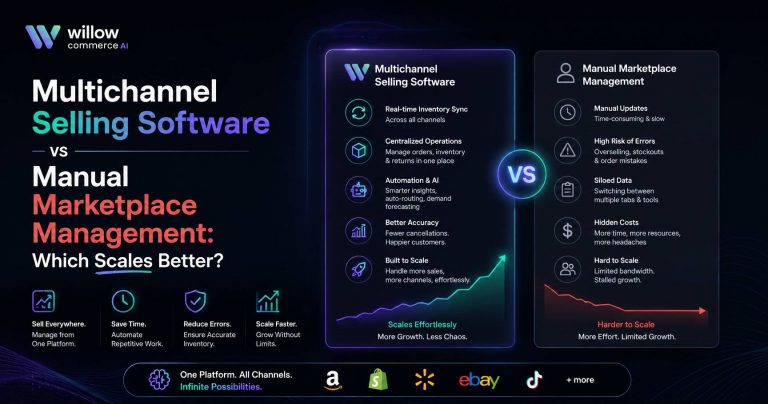
The result? Most multichannel sellers end up running TikTok Shop as a separate mini-business with its own inventory rules, fulfillment processes, and order management. That’s workable at 10 orders a day. At 200 orders a day, with TikTok’s SLA clock ticking, it becomes a liability.
Willow Commerce: Built for TikTok Shop from the Inside Out
This is where Willow Commerce fits differently from most platforms you’ll evaluate.
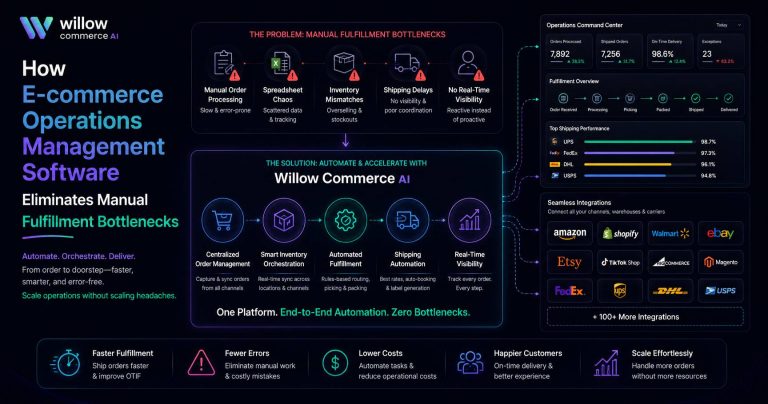
Willow Commerce doesn’t treat TikTok Shop as a new marketplace to bolt onto an existing framework. It’s integrated as a first-class channel alongside Amazon, Walmart, Shopify, eBay, Etsy, and the 80+ other marketplaces and sales channels the platform supports. What that means in practice:
Orders from TikTok Shop flow into the same unified queue as orders from every other channel. When a TikTok order lands, it goes through the same routing logic, picks up the same fulfillment rules, and enters the same pick-pack-ship workflow as an Amazon or Walmart order. No separate tab. No manual export from Seller Center. Your team works from a single dashboard, regardless of where the order originated.
Inventory syncs in real time across TikTok and every other connected channel. When a unit sells on TikTok, stock updates propagate to Amazon, Walmart, Shopify, eBay, and your own DTC store simultaneously. When a unit sells on Amazon, TikTok’s available quantity adjusts instantly. This is not a 15-minute batch sync. It’s the same real-time synchronization engine that prevents overselling across all channels, tuned for the burst-demand patterns that TikTok’s content-driven sales create.
Fulfillment workflows accommodate TikTok’s shipping model. Whether you’re using TikTok Shipping, managing your own carriers for non-USPS labels, or routing orders through a 3PL, Willow Commerce handles label generation, tracking uploads, and carrier compliance with TikTok’s requirements. You don’t need to process TikTok orders through a separate system to stay compliant with TikTok’s logistics framework.
Returns and after-sales are tracked within the same system. TikTok return requests, refund disputes, and performance metrics like LDR and SPS are visible alongside your Amazon and Walmart after-sales data. You can spot patterns, such as an SKU generating disproportionate returns on TikTok versus Amazon, which might indicate a listing-accuracy issue specific to that channel, without cross-referencing multiple seller dashboards.
Shipping optimization applies across all channels, including TikTok. Willow Commerce’s carrier rate shopping compares rates from USPS, UPS, FedEx, and other carriers to find the lowest-cost, fastest-delivery option for every order. For TikTok orders that require TikTok Shipping for USPS, the system routes appropriately. For orders where seller-generated labels are permitted, it optimizes across your full carrier network.
The Bigger Operational Picture
Running a TikTok Shop well is not just a TikTok problem. It’s a multichannel problem. The seller who maintains accurate inventory across TikTok, Amazon, Walmart, and Shopify simultaneously, while hitting each platform’s distinct SLAs, processing returns through each platform’s unique workflow, and keeping fulfillment costs optimized across all of it, is the seller who scales profitably.
Willow Commerce was built from day one as a single unified platform. There’s no patchwork of acquired products with separate logins and data silos. Catalog management, order processing, warehouse operations, shipping, returns, analytics, and AI-powered demand forecasting all live within a single system. Adding TikTok Shop to that stack is an integration flip, not an architectural overhaul.
For sellers evaluating whether TikTok Shop is worth the operational investment, the question isn’t whether the channel has enough demand. It clearly does. The question is whether your backend can absorb that demand without creating a second parallel operation. If your current setup requires you to manage TikTok in its own silo, you’re building a ceiling on how far you can scale before the manual overhead eats into your margins.
Frequently Asked Questions
TikTok originally planned to eliminate independent seller shipping by March 31, 2026, but paused that mandate on February 17, 2026. Seller shipping is still available with restrictions. All USPS labels must be generated through TikTok Shipping. The long-term direction is clearly toward platform-controlled logistics.
Technically possible, but risky. Amazon MCF’s standard shipping speed is 3 business days. TikTok’s dispatch SLA is 2 business days. Whether MCF meets TikTok’s requirements depends on the actual carrier scan timing, and some sellers report that MCF orders are not consistently scanned within TikTok’s window.
TikTok auto-approves the return and issues a refund at your expense. There’s no second chance. The response window is 48 hours for most items and 4 business days for items over $100.
Willow Commerce integrates with TikTok Shop’s fulfillment ecosystem. For FBT orders, inventory management and order tracking flow through the same unified dashboard. For seller-fulfilled orders, the platform handles label generation, tracking sync, and carrier compliance within TikTok’s shipping framework.
For “change of mind” returns (like “item doesn’t fit” or “no longer needed”), TikTok splits the return shipping cost with the seller. Your share depends on your Shop Performance Score. Sellers with strong SPS may have up to 80% of return costs covered by TikTok. Sellers with lower scores absorb a larger portion.
» Start Your Free Trial
Disclaimer: The information in this article is based on publicly available data, user reviews on platforms like G2, Capterra, and Trustpilot, and third-party public research sources as of early 2026. Product features, pricing, and capabilities change over time. We encourage readers to verify details directly with each vendor before making a purchasing decision.