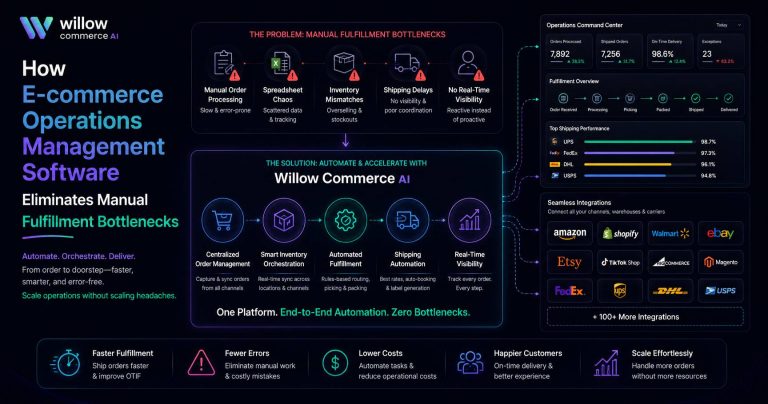

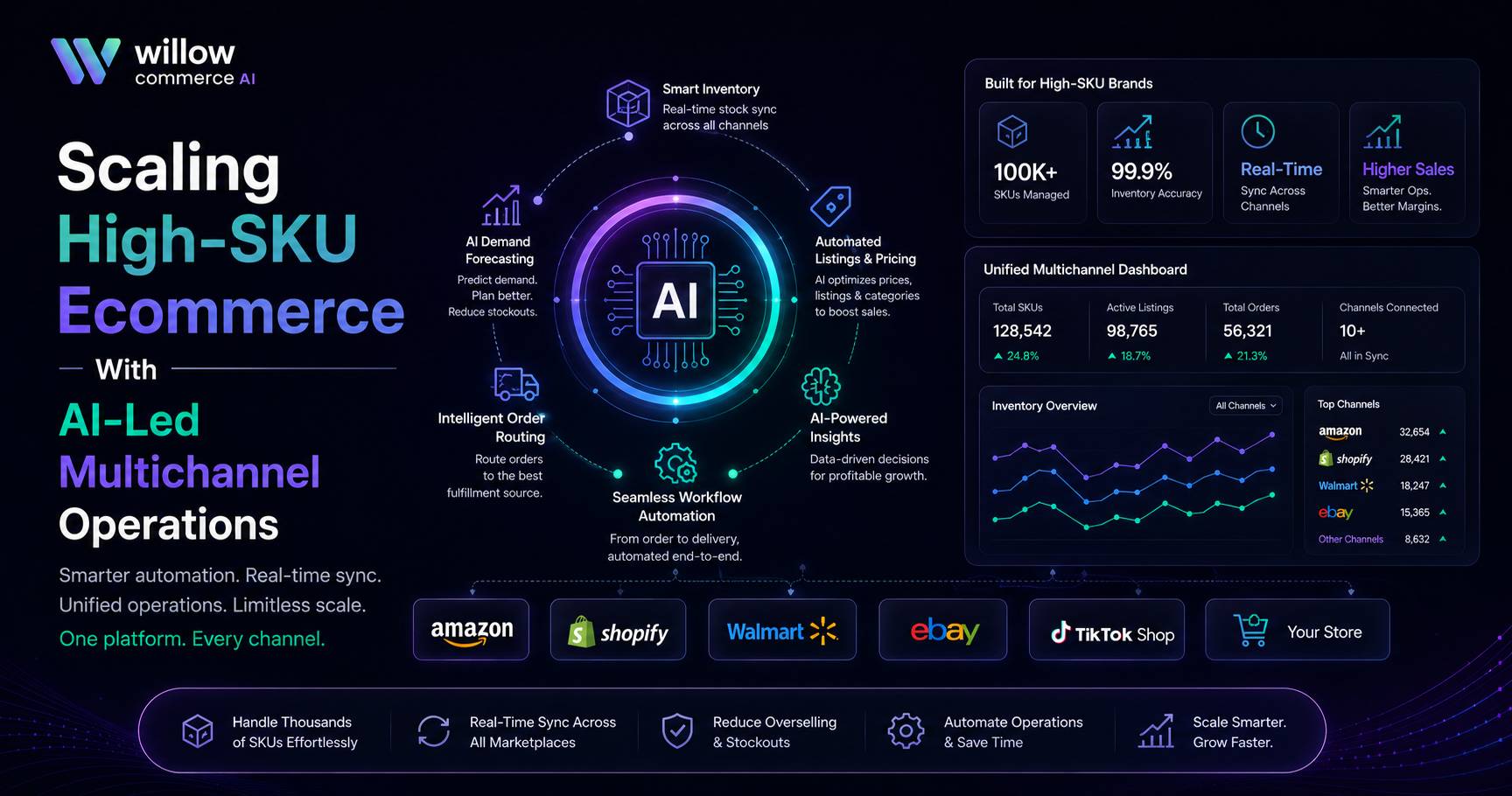

Do you manage thousands of SKUs and still depend on spreadsheets, marketplace tabs, and catalog fixes? An AI e-commerce platform gives high-SKU brands a controlled way to manage listings, stock, pricing, orders, and channel performance without making the team live inside error sheets.
One person edits Amazon titles. Someone else adjusts Walmart prices. Shopify inventory updates after the sale. A few units sell twice. Support takes the heat.
Why High-SKU E-Commerce Brands Struggle to Scale Manually
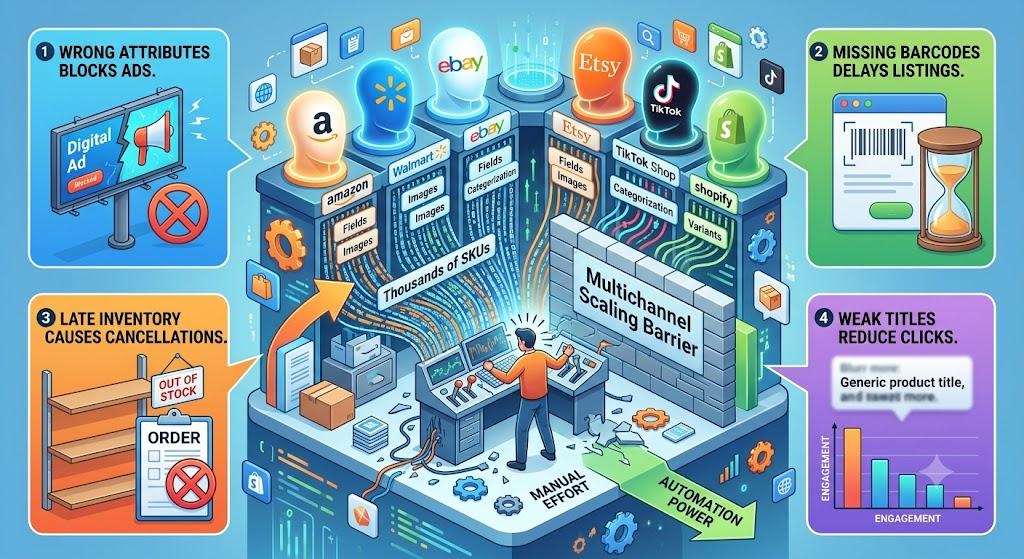
Small sellers can touch every listing by hand. Large sellers cannot. Once a catalog crosses a few thousand SKUs, every marketplace rule becomes a separate job. Amazon, Walmart, eBay, Etsy, TikTok Shop, and Shopify all bring different fields, images, categories, and variation formats.
Manual work hides problems until they cost money. Wrong attributes block ads. Missing barcodes delay listings. Late inventory updates cause cancellations. Weak titles reduce clicks for months.
AI-referred shoppers generated 53% more revenue per visit than non-AI traffic. That stat gives catalog quality real weight. If AI-led journeys send higher-value shoppers, sellers need product data that machines and buyers can read without confusion.
How an AI E-commerce Platform Cuts Daily Work for Large Catalog Teams
High-SKU work needs a better filter. Teams need software that can spot missing data, suggest edits, route exceptions, and separate urgent work from routine cleanup.
An AI e-commerce platform helps by taking repetitive catalog logic off the team’s plate. People still decide pricing rules, channel strategy, brand tone, and product priorities. The system handles the dull comparison work. Catalog managers spend less time copying data and more time reviewing items that need attention.
Faster Product Listing Across Multiple Channels
Speed matters when a seller runs seasonal drops, fast-moving accessories, or limited-stock products. Manual launches follow the same slow path: clean data, write titles, add bullets, choose categories, upload, fix errors, repeat.
A good AI e-commerce platform can create marketplace-ready listings from structured product data. It adjusts titles, bullets, descriptions, backend keywords, and image order by channel. The team still reviews the output, but the first draft no longer starts from a blank sheet.
Smarter SKU Mapping for Every Marketplace
SKU mapping looks simple from the outside. It is not. Bundles, multipacks, model numbers, regional names, color variants, and replacement parts create messy matches.
| Common Manual Issue | Better AI-Led Fix |
| Different SKU names | Match through titles, barcodes, attributes, and rules |
| Wrong variation groups | Separate color, size, model, pack count, and style |
| Category mismatch | Recommend a closer marketplace category |
| Duplicate products | Flag repeats before upload |
| Bundle confusion | Treat kits, packs, and units as separate logic |
AI/ML personalization increased e-commerce conversion rates by 10–15%. That lift depends on clean product data. If SKUs point to the wrong category or carry thin attributes, personalization has less to work with.
Automated Inventory Sync to Reduce Overselling
Overselling can hurt a store fast. Marketplaces track cancellations, late shipments, and customer complaints. One repeated stock error can lower account health.
An AI e-commerce platform connects inventory signals with marketplace activity and updates availability faster. When a unit sells on Walmart, it should not stay live on Amazon and Shopify.
Some sellers also need channel rules. They may hold stock for a high-margin marketplace or reserve units for fast shipping zones. Automation applies those rules without asking a person to watch every sale.
Dynamic Pricing That Protects Margins
Pricing should never become blind discounting. Many sellers cut prices because a competitor moves, then discover that fees, shipping, ads, and returns eat the deal.
Better repricing checks Buy Box movement, sales velocity, stock age, margin floor, and channel cost. The seller sets guardrails, then the system acts within those limits.
Unified Order Handling From One Dashboard
Order work gets messy when every channel lives in a separate tab. Teams check orders, cancellations, tracking, returns, refunds, and customer issues across too many screens.
A unified dashboard brings order activity into one workspace. Teams can see channel, SKU, customer status, fulfillment stage, and exception alerts without hunting through five systems.
At Willow Commerce, we focus on this kind of multichannel control because high-SKU sellers need one operating layer for listings, pricing, inventory, and orders.
Channel-Level Analytics for Better Selling Decisions
Growth does not mean every product belongs on every channel. Some products sell better on Amazon. Some move faster on Walmart. Niche products may perform better on Etsy or TikTok Shop.
Good analytics should show revenue, fees, shipping cost, ad spend, return rate, stockouts, and gross margin by channel. The better question is, “Where did we keep more money after costs?”
How Willow Commerce Helps High-SKU Sellers Manage Multichannel Growth
Willow Commerce fits sellers who manage large catalogs across many marketplaces. The platform connects more than 80 sales channels, supports AI-based listing improvements, keeps inventory synchronized, manages orders from one workspace, and uses pricing logic to protect margin. It treats multichannel selling as one connected operation.
For high-SKU teams, the strongest use cases include:
- AI-guided edits for titles, bullets, descriptions, backend keywords, and image order
- Marketplace connections across Amazon, Walmart, eBay, Etsy, Shopify, TikTok Shop, and more
- Stock updates designed to reduce overselling across active channels
- Profit-aware analytics that track revenue, fees, shipping, ad spend, and COGS
We help sellers identify which products fit which channels, so expansion becomes a measured operating decision rather than a rushed upload. The value comes from fewer disconnected tasks and tighter control over catalog movement, pricing actions, inventory availability, and order flow across every channel.
Where an AI e-commerce platform adds the Most Value in High-SKU Ecommerce Operations
AI adds the most value where volume, variation, and speed meet. Listing content, taxonomy, pricing, inventory, and returns creates too many signals for manual review.
High-SKU operations need systems that compare titles, attributes, margin rules, image order, stock levels, and channel behavior at once. That gives the team a cleaner queue.
Strong teams use AI as an operating assistant. Merchandising chooses assortment. Brand protects voice. Finance sets margin rules. Operations owns delivery standards. AI handles pattern work.
Conclusion
High-SKU ecommerce rewards teams that move fast without losing control. Manual work may carry early growth, but it breaks when catalog size, channel count, and order volume rise together. A strong AI e-commerce platform helps sellers manage listings, inventory, pricing, orders, and analytics with fewer disconnected steps.
Willow Commerce gives brands an organized way to run multichannel selling across marketplaces. Build cleaner operations with us and order your e-commerce growth around scale, control, and healthier margins.
Frequently Asked Questions
When does a high-SKU seller need automation?
Repeated catalog errors, slow launches, stock mismatches, and manual reporting show the team has outgrown its process.
Does AI replace e-commerce managers?
No. AI handles checks and suggestions. Managers still control strategy, pricing rules, brand direction, and channel priorities.
Why do marketplace listings need different content?
Each marketplace has different search behavior, field limits, category rules, and buyer expectations.
How can sellers avoid margin loss?
They should set price floors, include channel costs, track returns, and review profit after fees.
What should sellers check before adding channels?
They should review catalog readiness, inventory accuracy, fulfillment capacity, margin, return risk, and support workload.