

TL;DR
- Order management software (OMS) automates the full order lifecycle, from capture to returns
- It gives ecommerce teams real-time visibility and control across operations
- The right OMS can improve fulfillment speed by up to 40%
- For brands doing $5M to $500M+ across multiple channels, an OMS is no longer optional
- It acts as the central layer connecting inventory, fulfillment, and customer experience
- This guide covers how to choose, evaluate, and implement the right OMS.
What Is Order Management Software and Why Does It Matter for Ecommerce?
If your team has to use three different dashboards just to ship one order, you already feel the problem.
As ecommerce grows, fulfillment becomes harder to manage. Many large retailers rely on multiple disconnected systems, which leads to issues such as selling out-of-stock items, delayed deliveries, and unhappy customers.
Platforms like Willow Commerce solve this by bringing everything into one place. Product listings, inventory, orders, shipping, and warehouse operations are all managed in a single system, making it easier to handle more sales and more channels without the chaos.
“If you make customers unhappy in the physical world, they might each tell 6 friends. If you make customers unhappy on the internet, they can each tell 6,000 friends.”
– Jeff Bezos, Founder of Amazon
An OMS is a tool that helps you manage orders, inventory, and deliveries in one place.
It tracks everything from when an order is placed to when it is delivered. It also handles tasks such as processing orders, assigning stock, and displaying order status.
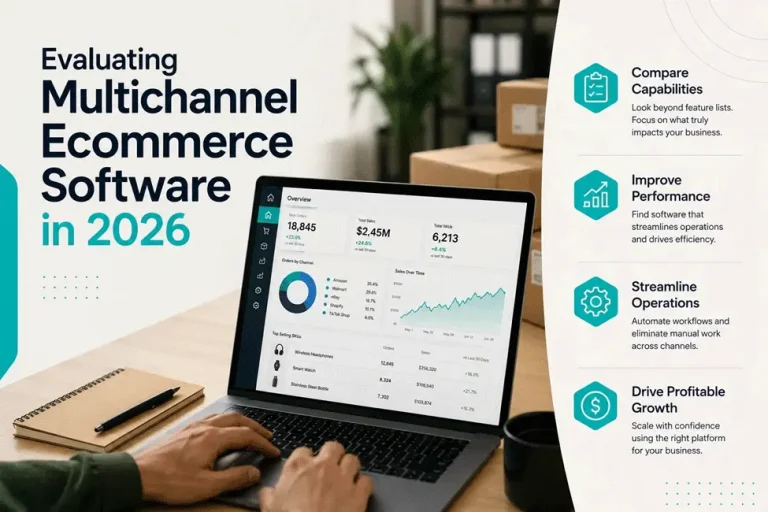
Instead of managing each sales channel separately, it connects them all within a single system. This reduces manual work, improves accuracy, and provides real-time updates across platforms such as Amazon, Walmart, and Shopify.
Why Native Platform Tools Stop Working at Scale
As your business grows, the basic order management tools that once worked start to fall short.
When you are handling thousands of orders across multiple channels and warehouses, things get messy. You start seeing issues such as overselling, manual errors, and shipping delays.
The complexity also increases fast. An OMS has to decide where to route orders, how to allocate inventory, and what promises to make to customers. And every new channel or location adds more moving parts.
At scale, even small mistakes matter. If you are processing 10,000 orders a day, just a 1% error rate means 100 wrong orders. During peak periods, that impact only gets bigger.
“The future of retail will be ‘retail everywhere.'”
– Harley Finkelstein, President of Shopify
According to the 2025 Unified Commerce Benchmark, 54% of shoppers regard delivery timelines and fulfillment options as critical purchasing factors. For Heads of Ecommerce and COOs accountable for fulfillment efficiency, that number should drive urgency.
How to Evaluate Order Management Software: Core Features That Drive ROI
Not all OMS platforms are equal. Evaluating them on the wrong criteria leads to expensive, disruptive implementations that fail to solve the actual problem. Here is what operations leaders should look for.
What Features Should a Mid-Market OMS Actually Include?
The best order management systems do more than track orders – they make active decisions, routing, promising, and optimizing across a network in real time. According to Gartner, the core capabilities that differentiate high-performing OMS platforms are order orchestration, enterprise inventory visibility, and real-time order status.
A well-scoped OMS evaluation should cover these functional areas:
- Intelligent order routing: Each order is automatically directed to the best fulfillment node based on proximity, stock availability, cost, and delivery promise – with realistic delivery windows calculated at checkout using live carrier, stock, and capacity data.
- Real-time inventory sync: Syncing inventory across all sales channels prevents stock discrepancies, improves demand forecasting, and reduces the risk of overselling.
- Returns management: Return authorization, restocking signals, and refund triggers should all be managed within the same system as forward fulfillment.
- ERP and WMS integration: An OMS manages process visibility across inventory and order status. An ERP handles broader functions like accounting and HR. WMS platforms focus on optimizing storage and labor within a distribution center.
- Analytics and reporting: Insights into order trends, performance, and bottlenecks.
Comparing Order Management Software: Which Platform Fits Your Operation?
We evaluated leading OMS platforms across integration depth, order-routing logic, multi-warehouse support, scalability, and fit for mid-market to enterprise use cases.
OMS Feature Comparison: Enterprise vs. Mid-Market vs. SMB Solutions
| Feature | Enterprise (e.g., Manhattan, Fluent) | Mid-Market (e.g., Willow Commerce, Linnworks) | SMB (e.g., Zoho, Ordoro) |
| Intelligent order routing | Yes | Yes | No |
| Multi-warehouse support | Yes | Yes | Limited |
| ERP integration (native) | Yes | Yes | No |
| 3PL connectivity | Yes | Yes | Limited |
| Real-time inventory sync | Yes | Yes | Yes |
| Returns management | Yes | Yes | Yes |
| Demand forecasting | Yes | Yes | No |
| API-first architecture | Yes | Limited | No |
Fluent Commerce dominates the ecommerce OMS space with its cloud-native distributed order management system, earning its position as a Leader in The Forrester Wave: Order Management Systems for Q1 2025, and excels at managing complex order flows between channels, warehouses, and partners.
Multi-Channel Capability Comparison
| Capability | Willow Commerce | Linnworks | Cin7 | Extensiv |
| Shopify integration | Yes | Yes | Yes | Yes |
| Amazon/Walmart | Yes | Yes | Yes | Yes |
| B2B/EDI support | Yes | Limited | Yes | Limited |
| Omnichannel fulfillment | Yes | Yes | Yes | No |
| Financial reconciliation | Yes | Limited | Yes | No |
| Demand forecasting | Yes | Limited | Yes | Limited |
Willow Commerce is an end-to-end retail operations platform for fast-growing ecommerce brands – automating order processing, integrating with Shopify, Amazon, and Magento, and featuring demand forecasting to optimize inventory.
Fit-for-Scale Comparison by Business Profile
| Criteria | Early-Stage ($1M-$5M) | Mid-Market ($5M-$100M) | Enterprise ($100M+) |
| Native Shopify OMS | Yes | No | No |
| Mid-market OMS (Willow Commerce, Linnworks) | No | Yes | Limited |
| Enterprise OMS (Manhattan, Fluent) | No | Limited | Yes |
| 3PL-native OMS (Flowspace) | No | Yes | Yes |
| ERP-embedded OMS (NetSuite) | No | Yes | Yes |
Platforms like Willow Commerce are built for this middle layer – where businesses have outgrown native tools but need a central source of truth connecting ecommerce platforms, 3PLs, ERPs, and shipping carriers without rebuilding the stack.
Willow Commerce’s automated order management system consolidates orders from multiple marketplaces into a single platform for streamlined fulfillment.
It automatically imports and processes orders, reduces manual errors and delays, sends tracking numbers back to marketplaces for customer updates, and enhances accuracy, expediting order processing and improving customer satisfaction
“E-commerce is not an industry; e-commerce is a tactic.”
– Tobias Lutke, CEO of Shopify
How to Implement Order Management Software?
Implementation is where most OMS projects stall or fail. Technology selection is only half the decision – program design matters equally.
Forrester notes that while the OMS market is mature, the gap between what platforms promise and what enterprises achieve remains wide.
Here is a phased approach to manage implementation risk:
- Map your current order flows first. Document every channel, fulfillment node, and exception scenario your team handles manually. This becomes your requirements foundation.
- Prioritize integrations by order volume. Connect your highest-volume channels first – typically your website and Amazon. Validate routing logic and inventory sync before expanding.
- Run parallel operations during cutover. Keep your existing system live for at least two to three weeks while the OMS processes real orders in a test environment. Compare outputs daily.
- Define your order routing rules explicitly. Automation speeds fulfillment by routing orders to the right warehouse, assigning carriers, and updating customers – reducing manual effort, minimizing errors, and ensuring faster deliveries.
- Set accuracy benchmarks before go-live. Today’s leading retailers are achieving 99.8% order accuracy alongside significant improvements in outbound throughput, inventory accuracy, and hourly picking times.
In AutoStore’s 2025 State of Warehouse Management and Fulfillment findings, 93% of surveyed executives rated improving throughput as very or extremely important – making a disciplined implementation approach non-negotiable for ops leaders who cannot afford fulfillment disruptions during a platform migration.
Frequently Asked Questions
An ERP manages internal functions like finance and procurement. An OMS manages orders across channels, handling routing, fulfillment, and tracking. In multi-channel ecommerce, the OMS runs operations, while the ERP handles reporting and reconciliation.
Frequent stockouts, high shipping costs, and manual workflows are key signs. If your team is routing orders, fixing inventory mismatches, or managing 3PLs outside Shopify, it’s time for a dedicated OMS.
Look for real-time inventory, multichannel order management, automated routing, warehouse and returns integration, analytics, and mobile access. Native integrations with Shopify, Amazon, Walmart, ERP systems, and 3PLs are essential.
ROI comes from reduced manual work, lower shipping costs, fewer errors, and better customer retention. An OMS centralizes operations and can automate up to 90% of workflows, significantly improving efficiency.
Focus on fulfillment cost per order, SLA performance, and customer lifetime value. Omnichannel customers typically have much higher LTV, making the investment easier to justify alongside cost savings.
Yes, depending on the platform. Strong OMS solutions like Willow Commerce can manage high-volume B2C fulfillment and complex B2B workflows from a single system, including inventory, orders, and integrations.
Conclusion
If you are running a growing ecommerce business, there comes a point where things start to break.
You have more orders and more sales channels, but your systems can’t keep up anymore. You start seeing disconnected tools, rising costs, and customers expecting faster, smoother delivery. That is a clear sign you have outgrown your current setup.
This is where the right OMS helps.
It does not just handle orders. It brings everything together. It determines the best way to fulfill each order, keeps inventory up to date across all channels, and gives your team clear visibility so they can focus on improving operations rather than constantly fixing problems.
Willow Commerce’s mission reflects this philosophy precisely: empowering each client to grow and thrive online by leveraging AI-powered cloud software to accelerate growth, streamline operations, and reduce costs. As Finkelstein has noted, the companies that get the foundational infrastructure right are the ones that scale from kitchen tables to market leaders.
Key Takeaways:
- A well-chosen OMS reduces manual work, syncs multi-channel orders, and improves fulfillment speed by up to 40%.
- Native tools like Shopify’s built-in OMS are sufficient for early-stage operations, but mid-market and enterprise brands need dedicated order orchestration with ERP and 3PL connectivity.
- According to Gartner, the core capabilities that set high-performing OMS platforms apart are advanced order orchestration, enterprise-grade inventory visibility, and real-time order tracking.
- Implementation success depends on program design, not just technology: map order flows, define routing rules, and run parallel operations before the full cutover.
- The ROI is clear and measurable. Leading retailers are reaching up to 99.8% order accuracy, while also improving shipping speed, inventory accuracy, and picking efficiency.
Start by reviewing how your orders are handled today and identify the top 3 areas where things go wrong or cost you the most. This could be due to inventory not matching, too many manual decisions, or split shipments that increase costs.
Then match these problems to what an OMS can fix. Use that as your starting point when choosing a platform.
The goal is simple. One system that becomes your single source of truth, connects all your tools, and can handle the level of complexity you already deal with.
Request a Demo to discover how Willow Commerce can reshape your multichannel inventory operations
» Start Your Free Trial