

Your morning starts with 47 orders in Shopify, 83 in Amazon, 22 in Walmart, and a handful scattered across eBay and your Shopify portal. By noon, your team has toggled between five browser tabs, manually compared UPS Ground rates against USPS Priority Mail dozens of times, and copied and pasted tracking numbers into three different systems.
This is daily life for multichannel sellers. And it’s exactly why shipping software exists.
When you’re selling across multiple channels like Amazon, Shopify, Walmart, and eBay simultaneously, the complexity compounds fast. Each platform has different shipping requirements, label formats, and carrier expectations. Amazon’s Buy Shipping wants you to use their preferred rates. Walmart enforces strict delivery promises. Shopify customers expect real-time tracking updates. Managing all of this manually isn’t just inefficient; it’s also dangerous. It’s a growth ceiling waiting to stop you.
The right shipping software pulls every order into one dashboard, automatically selects the best carrier based on package weight and delivery zone, prints batches of 4×6 thermal labels in minutes, and pushes tracking back to each sales channel. It turns a chaotic multichannel operation into a streamlined fulfillment workflow.
This guide covers what shipping software actually does, which features matter for growing businesses, and how to evaluate platforms for your specific operation.
What Is Ecommerce Shipping Software?
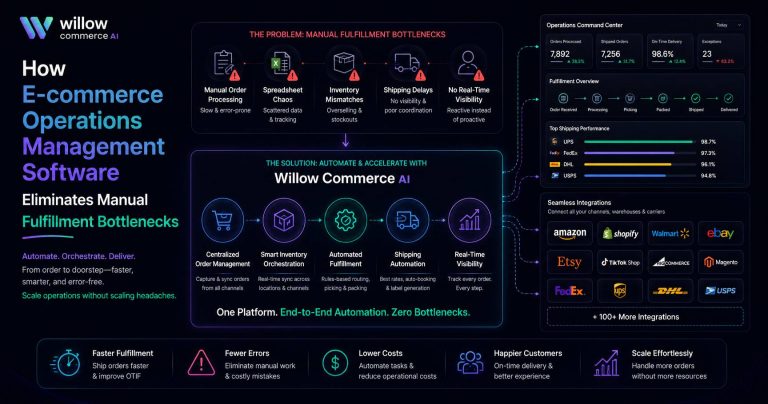
Ecommerce shipping software centralizes order fulfillment across multiple sales channels and automates the shipping process from label creation to delivery confirmation. Instead of logging into UPS, FedEx, and USPS separately for each shipment, you manage everything through a single platform.
Here’s the basic workflow: An order comes in from Shopify or Amazon. The shipping software automatically imports it, displays rate options from UPS, FedEx, USPS, and any regional carriers you’ve connected, generates a shipping label based on your selection or automation rules, and sends tracking information back to the customer and the originating sales channel.
Basic shipping tools stop at label printing and rate comparison. Full shipping and logistics software goes further:
- Syncs with your inventory management system to ship from the correct fulfillment location
- Applies automation rules based on package dimensions, weight, destination ZIP code, and delivery speed requirements
- Processes returns with automated RMA generation and return label creation
- Provides shipment visibility across your entire operation with reporting and analytics
Core functions of modern shipping software:
- Multichannel order import consolidates orders from Amazon FBA and FBM, Shopify, Walmart, eBay, BigCommerce, WooCommerce, Etsy, and other platforms into a unified order queue. No more switching between seller dashboards.
- Multi-carrier rate shopping compares real-time rates across UPS Ground, UPS 2nd Day Air, FedEx Home Delivery, FedEx Ground Economy, USPS Priority Mail, USPS Ground Advantage, and DHL eCommerce. You see the price difference between shipping Zone 4 versus Zone 8 before selecting a service level.
- Inventory-aware fulfillment connects to your warehouse management system or inventory software. If you operate multiple fulfillment centers, the platform routes orders to the location with available stock closest to the delivery address.
- Tracking and delivery updates automatically push shipment status to customers via email or SMS notifications and update the order status in each connected sales channel.

Why Shipping Software Matters for Multichannel Sellers
Selling on Amazon, Shopify, and Walmart simultaneously creates shipping complexity that manual processes can’t handle efficiently. Each channel has specific requirements, and mistakes directly impact your seller metrics, customer reviews, and profit margins.
The multichannel shipping challenge breaks down like this:
Amazon penalizes late shipments by issuing account health warnings and reducing Buy Box eligibility. If you’re fulfilling Merchant Fulfilled orders, you need to hit promised delivery dates consistently or risk losing visibility in search results.
Walmart enforces strict on-time delivery standards. Their seller scorecard tracks shipping performance, and consistently missing delivery windows can result in listing suppression or account suspension.
Shopify customers compare their experience to Amazon Prime. They expect fast shipping, accurate tracking, and proactive delivery updates. A poor post-purchase experience leads to negative reviews and lower customer lifetime value.
Managing these requirements manually across 100+ daily orders is unsustainable. Shipping software solves this by centralizing fulfillment and automating carrier selection.
Concrete benefits for multichannel operations:
- Reduced shipping costs through automated rate shopping. The software compares UPS, FedEx, and USPS rates for every package, factoring in dimensional weight pricing and zone-based rates. Multichannel sellers typically save $0.50 to $3.00 per shipment by consistently selecting the optimal carrier.
- Faster order processing with batch label printing and automated workflows. What takes 3-4 hours manually can be reduced to 30-45 minutes with properly configured automation rules.
- Fewer shipping errors through address validation, automated service level selection, and package dimension verification. This reduces reshipping costs, refund requests, and negative reviews from delayed deliveries.
- Consistent tracking updates across all channels. Customers who buy from your Amazon store, Shopify site, or Walmart listing receive accurate delivery information without manual data entry.
Key Features to Look for in Shipping Software
Not all platforms serve multichannel sellers equally. Some focus on single-channel Shopify merchants while others target enterprise 3PL operations. Here’s what matters for sellers managing multiple sales channels and fulfillment locations.
Core Shipping Capabilities
- Multi-carrier support with native connections to UPS, FedEx, USPS, DHL eCommerce, and regional carriers like OnTrac, LSO, and Spee-Dee. Negotiated rate import lets you use your existing carrier contracts rather than default retail pricing.
- Shipping label generation supporting 4×6 thermal labels via Zebra, DYMO, or Rollo printers, plus standard 8.5×11 paper labels. Batch printing should handle 100+ labels in a single job.
- Domestic shipping optimization with zone-based rate comparison, dimensional weight calculation, and service level matching. The platform should automatically identify when USPS Ground Advantage beats FedEx Ground for lightweight packages to Zone 5 destinations.
- Returns management, including customer-facing return portals, prepaid return label generation, RMA tracking, and inventory restocking workflows when items arrive back at your warehouse.
Advanced Features for Growing Multichannel Businesses
- Sales channel integrations with Amazon Seller Central, Shopify, Walmart, eBay, BigCommerce, WooCommerce, Etsy, Faire, and other platforms. Look for real-time order sync rather than batch imports, as batch imports can cause fulfillment delays.
- Warehouse routing rules that assign orders to specific fulfillment centers based on inventory availability, geographic proximity to the delivery address, or carrier pickup schedules. This matters when you’re shipping from multiple locations.
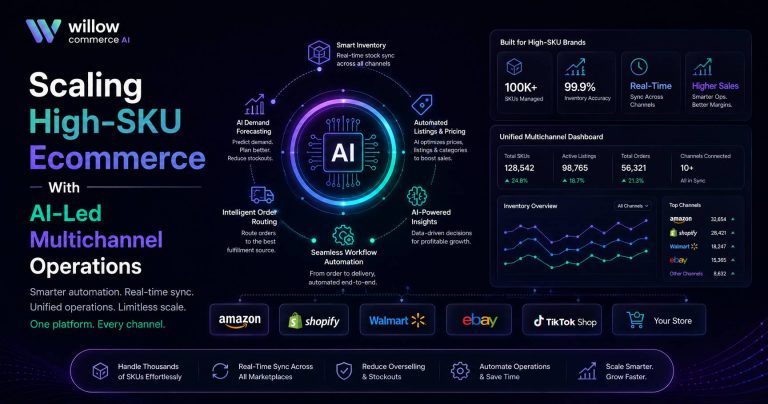
- Inventory synchronization that updates stock levels across all connected sales channels when orders ship. This prevents overselling on Amazon when Shopify orders deplete your warehouse inventory.
- Shipping automation rules use conditions like order weight, package dimensions, destination state, delivery speed, and order value. Example: Orders under 1 lb going to California automatically ship USPS Ground Advantage; orders over 5 lbs to the East Coast route to UPS Ground.
Cloud-Based Platform Advantages
- Browser-based access with no software installation required. Your warehouse team, remote staff, and you can all access the same dashboard from any computer.
- Automatic carrier API updates keep you connected to the latest USPS, UPS, and FedEx rate tables and service offerings, without manual upgrades.
- Scalable infrastructure that handles 50 orders per day or 5,000 without performance slowdowns during Q4 peak season or Prime Day surges.
Willow Commerce Shipping Capabilities
Willow Commerce combines shipping label generation, inventory management, and multichannel order management in a single platform built for US-based ecommerce sellers. Instead of connecting separate tools for inventory, orders, and shipping, everything runs from a single system.
Shipping for Multichannel Ecommerce
For sellers managing Amazon, Shopify, Target Plus, and other channels, Willow Commerce provides:
- Unified order dashboard pulling orders from all connected sales channels into a single fulfillment queue. Filter by channel, shipping priority, or fulfillment location without switching between Amazon Seller Central and Shopify admin.
- Automated carrier selection using rules you define. Set conditions based on package weight, dimensional weight, destination zone, and required delivery speed. A 12 oz package to Zone 3 might automatically route to USPS Ground Advantage, while a 10 lb package to Zone 7 selects UPS Ground.
- Batch label printing for high-volume fulfillment. Process 200+ orders in a single batch, generate labels for your Zebra ZP450 or Rollo printer, and automatically update tracking across all sales channels.
- Rate shopping across carriers, comparing UPS, FedEx, USPS, and DHL eCommerce rates in real time. See the exact cost difference between FedEx Home Delivery and USPS Priority Mail before printing each label.

Omnichannel Retail Shipping
For sellers operating both ecommerce channels and physical retail locations, Willow Commerce enables:
- Ship-from-store fulfillment using retail locations as distribution points. When your main warehouse runs low on inventory, route orders to a store location with available stock.
- Inventory visibility across locations shows real-time stock levels at each warehouse and retail store. Fulfillment decisions factor in what’s actually available, not what your system showed yesterday.
- Unified order management handling online orders, in-store purchases, and buy-online-pickup-in-store (BOPIS) from one platform.
Cloud-Based Shipping Management
Willow Commerce runs entirely in the cloud:
- No desktop software to install or maintain
- Access from warehouse workstations, office computers, or mobile devices
- Automatic updates to carrier integrations and platform features
- Infrastructure that scales with your order volume through peak seasons
Willow Commerce vs Other Ecommerce Shipping Software
Here’s how Willow Commerce compares to other shipping platforms popular with multichannel sellers:
| Feature | Willow Commerce | ShipStation | Shippo | Easyship |
| Multichannel order sync | Amazon, Shopify, Walmart, eBay, +50 More | Amazon, Shopify, Walmart, eBay, + 50 More | Shopify, limited marketplace support | Amazon, Shopify, eBay |
| Inventory management | Built-in | Requires separate integration | No | No |
| Carrier connections | UPS, FedEx, USPS, DHL, regionals | UPS, FedEx, USPS, DHL, regionals | UPS, FedEx, USPS, DHL | 250+ carriers, international focus |
| Warehouse routing | Multi-location with inventory sync | Basic multi-location | Single origin | Limited |
| Automation complexity | Advanced rule builder | Moderate automation | Basic rules | Moderate automation |
Platform-by-platform breakdown:
ShipStation is the most established shipping software for ecommerce sellers. It handles multichannel order import well and offers solid carrier integrations with UPS, FedEx, and USPS. The limitation appears when you need inventory management alongside shipping. ShipStation requires connecting to a separate inventory system, which creates data synchronization issues and additional subscription costs.
Shippo focuses on carrier rate shopping and is well-suited for Shopify primary sellers with straightforward shipping needs. Marketplace integrations are more limited, making it less suitable for sellers doing significant volume on Amazon or Walmart. No built-in inventory management.
Easyship focuses on international shipping, connecting with 250+ carriers worldwide. For US domestic shipping, it’s less optimized than platforms focused specifically on the US market. Better suited for cross-border sellers than domestic multichannel operations.
Willow Commerce combines shipping, inventory management, and multichannel order handling. This integrated approach eliminates the need to sync data between separate systems and provides fulfillment decisions based on real-time inventory availability across locations.

Best Shipping Software by Use Case
Best Shipping Software for Multichannel Sellers
If you’re selling on Amazon, Shopify, and Walmart simultaneously, prioritize:
- Native integrations with each marketplace that sync orders in real time, not hourly batches
- Unified order queue showing all channels in one dashboard with filtering and sorting options
- Channel-specific compliance handling Amazon Buy Shipping requirements, Walmart delivery promises, and Shopify tracking updates automatically
- Inventory sync is preventing overselling when orders from multiple channels hit the same SKU
Willow Commerce serves multichannel sellers by treating inventory, orders, and shipping as connected functions rather than separate systems that require integration.
Best Shipping Software for Small Ecommerce Businesses
Small sellers processing 20-100 orders daily need:
- Fast setup without weeks of implementation or technical configuration
- Affordable pricing that scales with shipment volume rather than requiring enterprise commitments
- Core automation, like batch label printing and basic carrier selection rules
- Room to grow into advanced features as order volume increases
Avoid platforms that price based on user seats or charge premium rates for marketplace integrations you’ll need as you expand to additional sales channels.
Best Shipping Software for Retail and Ecommerce
Businesses operating physical stores alongside ecommerce channels need:
- Location-based inventory tracking showing stock at each store and warehouse
- Flexible fulfillment routing directs orders to stores, warehouses, or drop-ship vendors based on availability
- POS integration connects in-store sales to your inventory and order management system
- Ship-from-store workflows enabling retail locations to fulfill online orders
Willow Commerce supports this model by treating all locations as potential fulfillment points with unified inventory visibility.
Cloud-Based Shipping Software vs Legacy Desktop Systems
Many sellers still use desktop shipping software or older systems requiring local installation. Here’s why cloud platforms have become the standard for multichannel operations:
| Cloud-Based Shipping Software | Legacy Desktop Systems |
| Access from any browser | Installed on specific computers |
| Automatic carrier API updates | Manual software updates required |
| Scales with order volume | Performance limits at high volume |
| Real-time multichannel sync | Batch imports and sync delays |
| Multi-user access built in | Additional licenses per workstation |
Why cloud platforms win for multichannel sellers:
- Real-time order sync is essential when selling on Amazon and Shopify simultaneously. Cloud platforms pull orders instantly. Desktop software often batches imports, creating fulfillment delays during high-volume periods.
- Carrier rate updates happen automatically. When USPS updates Ground Advantage pricing or FedEx adjusts dimensional weight factors, cloud platforms reflect the changes immediately. Desktop software requires manual updates that often get delayed.
- Multi-location access lets warehouse staff, customer service teams, and management all work from the same system. Desktop installations limit access to specific workstations.
- Peak-season scaling handles Q4 holiday volume, Prime Day surges, and promotional spikes without degrading performance. Cloud infrastructure scales automatically while desktop systems reach hardware limits.
How to Choose the Right Shipping Software
Selecting shipping software affects your daily operations for years to come. Use this evaluation process to match platforms to your specific requirements.
Step 1: Map your sales channel requirements
List every platform where you sell: Amazon (FBA, FBM, or both), Shopify, Walmart, eBay, BigCommerce, WooCommerce, Etsy, and wholesale portals. Confirm that any shipping software you consider has native integrations with each channel. Third-party connector apps add cost and introduce synchronization reliability issues.
Step 2: Calculate your volume and growth trajectory
Document your current daily order volume by channel. Project where you’ll be in 12-18 months. Some platforms price attractively at 500 monthly shipments, but become expensive at 5,000. Others require minimums that don’t make sense for smaller operations. Model costs at current volume and 3x growth.
Step 3: Evaluate inventory integration requirements
If you manage inventory across multiple warehouses or need fulfillment decisions based on stock availability, you need shipping software with built-in inventory management or tight integration with your existing IMS. Separate systems create overselling risks and fulfillment routing problems.
Step 4: Test with your actual workflow
Run a trial using real orders, your actual products, and your current carrier accounts. Process a full day’s worth of orders on the platform. How long does batch label printing take? Test automation rules with different package sizes and destinations. Evaluate the learning curve for your warehouse team.
Evaluation checklist:
- Native integrations with all current sales channels (Amazon, Shopify, Walmart, etc.)
- Carrier connections for UPS, FedEx, USPS, with your negotiated rates
- Batch label printing supporting your thermal printer hardware
- Automation rules matching your shipping decision logic
- Inventory sync across fulfillment locations (if applicable)
- Pricing aligned with current volume and projected growth
- Implementation timeline and onboarding support
Common Mistakes When Selecting Shipping Software
Avoid these errors that create switching costs and operational headaches:
- Choosing based on label cost alone. Pirate Ship and similar platforms offer cheap USPS rates, but lack the multichannel order management and automation that growing sellers need. You’ll save $0.10 per label by eliminating hours of manual work that shipping software automates.
- Ignoring inventory integration. Selecting shipping-only software when you need inventory management creates data silos. You’ll either buy a separate inventory system later (and manage integration headaches) or struggle with manual stock updates and overselling.
- Underestimating automation needs. Processing 50 orders daily feels manageable manually. At 200 orders, you need automation rules to handle carrier selection, service-level matching, and warehouse routing, without human intervention for every package.
- Selecting marketplace-specific tools. Some platforms optimize heavily for Amazon FBA prep or Shopify-only operations. If you sell across multiple channels, ensure the software treats each marketplace equally.
- Skipping the trial period. Demos show best-case scenarios. Trial periods reveal how the software handles your edge cases: unusual package dimensions, split shipments, address validation failures, and carrier pickup scheduling.
- Overlooking implementation effort. Migrating to new shipping software involves connecting carrier accounts, integrating sales channels, configuring automation rules, and training the team. Budget 2-4 weeks for proper setup rather than expecting same-day operation.
Shipping is where your multichannel selling strategy meets physical reality. Every order fulfilled accurately and on time reinforces customer trust, which drives repeat purchases and positive reviews. Every late shipment, tracking failure, or wrong-item delivery damages your seller metrics and customer relationships.
For sellers managing Amazon, Shopify, Walmart, and other channels simultaneously, shipping software isn’t optional. It’s infrastructure. The right platform:
- Consolidates orders from every sales channel into one fulfillment workflow
- Automates carrier selection based on package characteristics and destination zones
- Syncs inventory across locations to prevent overselling and optimize fulfillment routing
- Scales with your growth without proportional increases in fulfillment staff
Willow Commerce was built for US-based multichannel sellers who need shipping, inventory, and order management working together in one system. For growing businesses that have outgrown basic label-printing tools but don’t need the enterprise-level logistics complexity, it’s worth evaluating how the platform fits your operation.
Your shipping process either enables growth or constrains it. Make sure it’s the former.
» Ready to ship smarter? Let Willow Commerce simplify your inventory and shipping management today.
» Start Your Free Trial