


Most ecommerce sellers think they understand demand forecasting. They pull last quarter’s numbers, add a percentage bump, maybe glance at a seasonal trend, and call it planning. It works well enough until it doesn’t. And when it doesn’t, you’re sitting on $40,000 worth of slow-moving inventory or scrambling to restock your top seller during the exact week your ads finally started converting.
AI demand forecasting is not some incremental upgrade to that spreadsheet. It is a fundamentally different way of predicting what your customers will buy, when they’ll buy it, and how much they’ll need. But to understand why it matters, you need to look past the marketing language and into the mechanics.
TL;DR
| Question | Quick Answer |
| What is AI demand forecasting? | Machine learning models that analyze sales history, seasonal patterns, marketplace signals, and external factors to predict future product demand at a granular level |
| How does it differ from a moving average? | Moving averages react to the past. ML models learn from hundreds of variables simultaneously and adapt as new data arrives |
| How accurate is it? | ML-driven forecasting typically reduces forecast error by 20% to 50% compared to traditional methods |
| Do I need an OMS for it to work? | Yes. Accurate forecasting depends on clean, unified multichannel order data flowing into the model in real time |
| Who benefits most? | Mid-market and enterprise multichannel sellers managing inventory across Amazon, Walmart, Shopify, eBay, and other channels |
How AI Demand Forecasting Actually Works
At its core, AI demand forecasting uses machine learning algorithms to consume large volumes of structured data (sales history, inventory levels, pricing changes, promotional calendars) alongside semi-structured signals (marketplace competition, seasonal shifts, even weather patterns) and produce a statistical prediction of future demand for each SKU.
The “AI” part is not one algorithm. Modern forecasting engines deploy an ensemble of models, each suited to different patterns in your data.
Time series models like ARIMA and exponential smoothing are the workhorses. They detect recurring patterns, seasonality, and long-term trends in sequential data. Many data scientists still use ARIMA as a baseline benchmark when evaluating newer approaches.
Gradient boosting models like XGBoost and LightGBM take a different approach. Instead of looking at one time series, they ingest dozens or hundreds of features at once: price changes, competitor activity, day-of-week effects, promotional flags, and inventory position. They build ensembles of decision trees that collectively produce a more nuanced prediction than any single model could.
Deep learning architectures such as LSTM networks handle the messy, nonlinear patterns that trip up simpler approaches. A sudden TikTok trend that sends demand for a niche product through the roof? An LSTM trained on social engagement data alongside sales data has a better shot at catching that signal early.
The critical piece tying it all together is automatic model selection. A well-built forecasting engine tests multiple approaches against your actual data, evaluates accuracy using metrics like Mean Absolute Error and WMAPE, and selects the best performer for each SKU. Some products have clean seasonal patterns that ARIMA handles beautifully. Others are erratic and need the brute-force pattern matching of XGBoost. A good system knows the difference.
The Data That Feeds the Model
| Data Category | Examples | Why It Matters |
| Historical sales | Order volume by SKU, channel, and time period | The foundational signal for any forecast |
| Inventory position | Current stock, in-transit quantities, warehouse allocation | Prevents forecasting demand you can’t fulfill |
| Pricing and promotions | Price changes, discount events, and coupon usage | Price drops drive demand spikes; the model must account for |
| Marketplace signals | Holidays, Prime Day, Black Friday, back-to-school | Recurring events with predictable demand patterns |
| Supplier lead times | Vendor lead times, reorder cycles, and MOQ constraints | Aligns the forecast with what you can actually procure |
Aligns the forecast with what you can actually procure
If you’ve ever used =AVERAGE(B2:B13) to estimate next month’s sales, you’ve done moving average forecasting. It is the most common approach among small and mid-size sellers, and it is deeply limited.
A simple moving average takes your last N periods, averages them, and calls that your forecast. No adjustment for seasonality. No consideration that you ran a 20% off promo in month two. No recognition that a competitor just went out of stock and temporarily sent buyers your way.
Weighted and exponential smoothing improve on this slightly, but they share the same blind spot: they only look backward at one variable and assume the future will resemble the recent past.
Machine learning breaks that assumption wide open. Based on consulting benchmarks, ML projects typically deliver a 5% to 20% reduction in forecast error compared to a moving average. At scale, McKinsey estimates that AI-powered supply chain forecasting cuts product unavailability by up to 65%.
| Factor | Moving Average | Machine Learning |
| Input variables | Past sales only | Sales, pricing, competition, inventory, external signals |
| Seasonality handling | Manual seasonal indices required | Automatically detects complex seasonal patterns |
| Promotional impact | Ignores it | Quantifies demand lift and factors in future promotions |
| Adaptation speed | Slow; needs multiple periods | Near real-time updates as new data arrives |
| New product forecasting | Cannot forecast without history | Uses analogous product data and category trends |

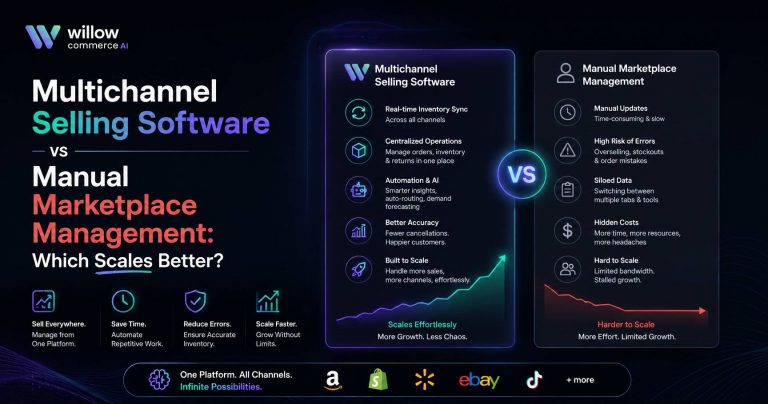
For a multichannel seller doing $5 million in annual revenue, a 30% reduction in forecast error can translate to tens of thousands in recovered lost sales and reduced carrying costs. The moment you sell across Amazon, Walmart, Shopify, and eBay simultaneously, the number of interacting variables explodes beyond what any moving average can capture.
Willow Commerce’s AI-Powered Forecasting
Most forecasting tools operate in isolation. You export sales data, upload it to a separate analytics platform, generate a forecast, and then manually feed those numbers back into purchasing decisions. Every step introduces lag, error, and the risk that your data is stale by the time you act.
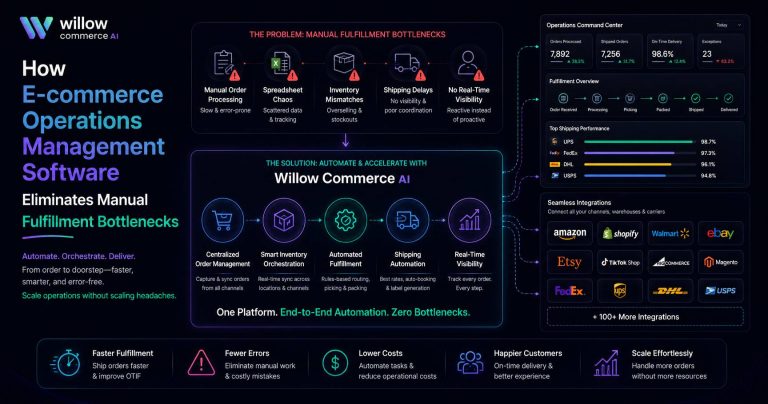
Willow Commerce eliminates that gap by embedding its machine learning forecasting engine directly into the same system that manages orders, inventory, and fulfillment. The forecasting engine draws on real-time, multichannel order data, not a CSV export from two weeks ago. It sees every order from Amazon, Walmart, Shopify, eBay, Etsy, TikTok Shop, and 80+ other marketplaces in real time.
The system analyzes historical sales data, seasonal patterns, and marketplace demand signals to predict future inventory needs at the SKU level. It then generates purchase order recommendations to maintain optimal stock while minimizing both overstock and stockouts.
What makes this architecture compound in value:
- Channel-level forecasting. The model doesn’t just know you sold 500 units last month. It knows 200 sold on Amazon, 150 on Walmart, 80 on Shopify, and 70 on eBay, and forecasts each independently because demand dynamics differ across platforms.
- Pricing intelligence feedback. Willow Commerce’s AI-driven repricing feeds competitive pricing data back into the demand model, creating a loop between pricing strategy and demand prediction.
- Profitability-weighted output. Because forecasting, inventory, orders, and shipping optimization all live in one system, you’re not just forecasting demand. You’re forecasting profitable demand, with SKU-level and channel-level margin data baked into the recommendations.
A seller running a separate forecasting tool alongside a separate OMS, WMS, and shipping platform is always working with fragmented, delayed data. The forecast might be technically accurate, but by the time it translates into a purchasing decision, conditions have shifted.
Why You Need an Order Management System
Here’s a truth that doesn’t get enough attention: your forecasting accuracy is capped by the quality of your order data.
You can deploy the most sophisticated ML model available, but if the data feeding it is incomplete, delayed, or siloed by channel, the output will be unreliable.
Consider the typical multichannel seller without a unified OMS. They have Amazon Seller Central tracking Amazon orders, Walmart Seller Center for Walmart, a Shopify backend for DTC, eBay’s seller hub for eBay, maybe a 3PL portal or two, and a spreadsheet trying to reconcile everything. Each system holds a piece of the demand picture. None holds the complete picture.
When you pull exports from five platforms, reconcile date formats, normalize SKU identifiers (Amazon uses ASINs, Walmart uses their own IDs, Shopify uses your internal SKUs), and merge everything into one dataset, you’ve already introduced dozens of error points. And the data is stale. Most sellers run these reconciliation exercises weekly or monthly. A lot changes in a week.
A centralized order management system solves this by aggregating all order data from every channel into a single, normalized data stream in real time.
| Capability | Impact on Forecast Quality |
| Real-time order ingestion | Forecasts reflect current demand, not last week’s snapshot |
| Unified SKU mapping | No mismatched identifiers causing data fragmentation |
| Channel-level segmentation | Separate forecasts per marketplace, not blended averages |
| Returns and cancellation tracking | Net demand gives a more accurate signal than gross orders |
| Inventory position visibility | The model knows what was available to sell, not just what sold |
That last row is subtle but critical. If a product was out of stock for two weeks, sales data shows zero, but true demand wasn’t zero. Integrated systems let sophisticated models estimate what demand would have been, preventing chronic under-forecasting.
Integrate Directly with Multichannel Order Data
“Integration” gets thrown around loosely. True multichannel data integration means your forecasting system receives normalized, enriched order data without manual intervention.
That requires live API connections (not CSV exports) to every sales channel. It requires a central catalog that maps ASINs, Walmart listing IDs, Shopify variants, and eBay item numbers to one internal SKU. It requires full order lifecycle tracking, from placement through fulfillment, return, and refund, because a placed order is not the same as a fulfilled one.
For sellers operating multiple warehouses or mixing FBA, 3PL, and self-fulfillment, the model also needs location-specific demand data. If 60% of your Amazon orders ship from the East Coast, replenishment recommendations need to reflect that split.
When this comes together, sellers typically see fewer stockouts, lower excess inventory, faster inventory turns, and stronger marketplace performance. Maintaining healthy stock levels protects your search ranking and Buy Box eligibility on Amazon, which directly feeds back into demand.
Frequently Asked Questions
Not with the same confidence as an established SKU, but good ML models use analogous product data, category trends, and attribute similarity for initial forecasts. As sales data accumulates, the model shifts to actual-data-based predictions.
Most systems require at least six months. Twelve months is better for seasonal products, since the model needs at least one full annual cycle to identify seasonal patterns.
No. It replaces the repetitive data processing humans do poorly and augments the strategic judgment humans do well. The best outcomes come from AI-generated baselines refined by experienced planners.
It depends more on complexity than on size. A seller with 30 SKUs in a single Shopify store probably doesn’t need ML-based forecasting. A seller with 200 SKUs across Amazon, Walmart, and their own store who runs promotions and manages FBA limits will see real value. The threshold isn’t revenue. It’s the number of variables you’re managing simultaneously.
5 Common Mistakes That Kill Demand Forecast Accuracy
Even with the right tools, these errors trip up multichannel sellers consistently:
- Training on gross orders instead of net demand. If your return rate is 15% and your model doesn’t account for it, every forecast is inflated by 15%. Sounds obvious. You would be surprised how many sellers make this mistake.
- Ignoring channel cannibalization. Launching on a new marketplace doesn’t always create net new demand. Sometimes it shifts existing customers from one channel to another. If your Walmart launch pulls 20% of your Amazon volume, a per-channel model will overestimate total demand unless it accounts for the substitution effect.
- Using stale data for fast-moving categories. Monthly data refreshes are inadequate for categories where demand shifts weekly. Consumer electronics accessories, trending fashion items, and seasonal products require real-time or near-real-time data feeds to keep forecasts relevant.
- Treating all SKUs equally. Your top 20% of SKUs probably generate 80% of your revenue. Spending the same forecasting effort on a slow-moving accessory as on your flagship product is a misallocation of analytical resources. Good forecasting systems apply more granular modeling to high-impact SKUs and simpler approaches to the long tail.
- Confusing constrained demand with true demand. If a product was out of stock for two weeks last month, the sales data from that period shows zero, but true demand wasn’t zero. Sophisticated models estimate what demand would have been based on pre-stockout trends and comparable products. If your model treats stockout periods as genuine zero-demand periods, it will chronically under-forecast.
» Start Your Free Trial
Disclaimer: The information in this article is based on publicly available data, user reviews on platforms like G2, Capterra, and Trustpilot, and third-party public research sources as of early 2026. Product features, pricing, and capabilities change over time. We encourage readers to verify details directly with each vendor before making a purchasing decision.