
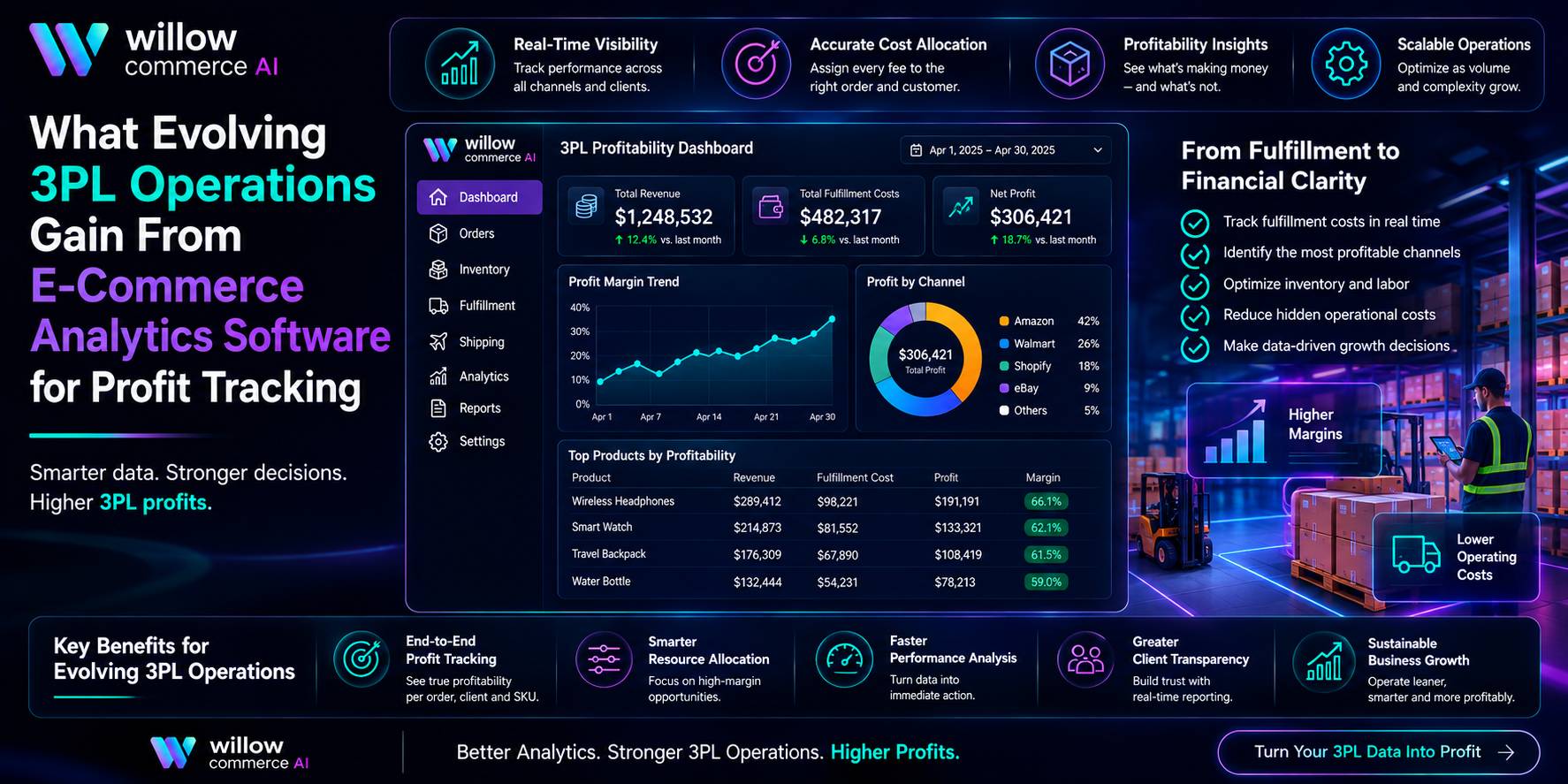

Have you ever watched order volume climb while profit stays almost flat? The warehouse looks busy, yet the numbers do not move the way you expected.
That is where software for 3pl companies becomes useful. A growing 3PL needs to know what each account costs to serve, what that account earns, and which activities keep cutting into margin. E-commerce analytics software can connect orders, storage, shipping, returns, billing, and client revenue in one operating picture. More volume looks impressive. Margin tells the harder story.
Why Profit Tracking Becomes Harder as 3PL Operations Expand
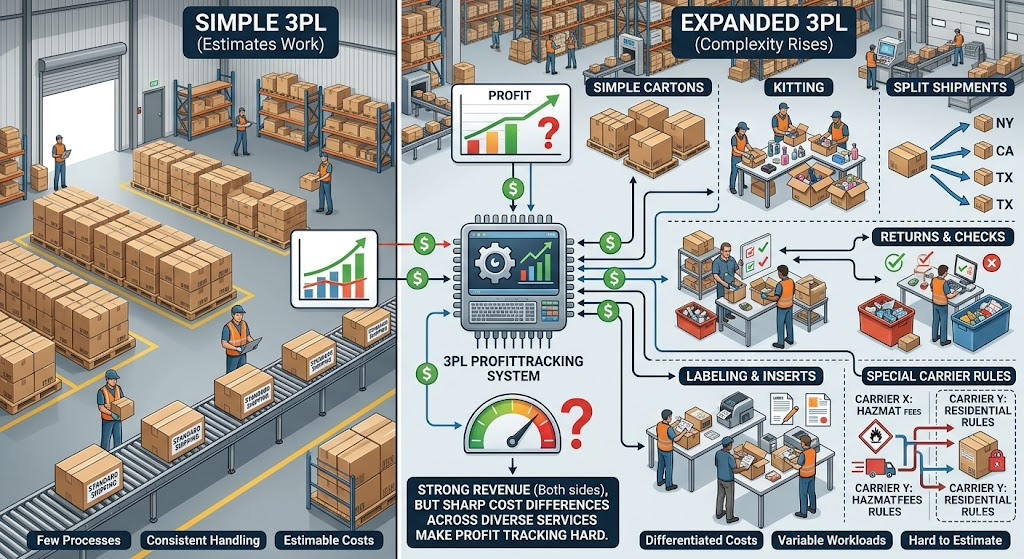
A smaller 3PL can survive on rough estimates for a while. Growth changes that. One client may send simple cartons. Another may need kitting, relabeling, split shipments, return checks, inserts, or special carrier rules. Both can generate strong revenue, yet their costs may differ sharply.
This is where per-client analytics 3pl software earns attention. It places revenue alongside labor, storage, shipping, returns, and exceptions. Managers stop relying on warehouse totals and see which customers consume more resources than billing covers. A profitable warehouse can carry weak accounts. Account data exposes them.
How E-Commerce Analytics Software Supports More Profitable 3PL Operations
E-commerce analytics software helps 3PL teams connect everyday warehouse activity with the revenue and cost behind each client account. It shows where margins tighten, which services consume more resources, and where pricing or workflow changes may be needed.
Tracking Revenue With Per-Client Analytics 3PL Software
Revenue alone can fool a busy operation. A client billing $90,000 each month may need extra labor, heavy storage, and frequent shipment exceptions. Another billing $60,000 may run with fewer touches.
Software for 3pl companies should connect revenue with the work behind it. Client profitability reporting can place handling effort, carrier spend, storage use, returns, and special requests next to revenue.
The better question is which accounts leave enough contribution after the warehouse finishes the work.
Finding High-Cost Fulfillment Activities Before They Reduce Margins
Small warehouse inefficiencies rarely look serious alone. Across thousands of orders, they become expensive.
Extra walking, weak batch logic, repeated scans, and poor replenishment all add labor cost. Research on AI-based order batching found that it reduced picker travel distance by 27.25% compared with traditional single-order picking.
A 3PL can track travel time, picks, touches, exceptions, and labor minutes by client. If one account creates repeated handling, operations can change the process or review the fee.
Comparing Shipping Costs and Markups Across Client Orders
Shipping margin can disappear in small pieces. Zone changes, dimensional weight, fuel surcharges, premium services, residential charges, and packaging choices can raise costs. Old client rate cards make it worse when shipment patterns change.
Analytics lets teams compare carrier cost with client billing by order and account. That exposes weak markups, expensive service selections, and packaging choices that push parcels into higher-cost brackets.
The 3PL can then fix the part of the shipping model instead of raising fees across every account.
Connecting Warehouse Activity With 3PL Client Onboarding Software
Profit problems often start during setup. When storage fees, return charges, packaging rules, carrier preferences, and special handling terms live across emails, teams can perform billable work without applying the right charge.
Good 3pl client onboarding software should connect commercial terms with warehouse activity from the first order. Operations can follow client rules, while finance can trace charges back to recorded work. That shortens invoice review when a client questions a fee.
Monitoring Inventory Movement Against Storage and Handling Revenue
Inventory creates cost before an order ships. Receiving, putaway, replenishment, relocation, cycle counts, damaged-stock checks, and long-term storage all use labor or space.
Machine-learning fulfillment forecasting has achieved up to 14% higher prediction accuracy than an existing rule-based system. Better forecasts can help teams plan labor, replenishment, slotting, and capacity with fewer last-minute changes.
Analytics should compare inventory activity with receiving, storage, movement, and outbound revenue. That reveals accounts whose warehouse use grows faster than the fees attached to it.
Identifying Client Accounts That Require Pricing Adjustments
Pricing reviews should start with account data, not frustration.
| Profit Signal | What To Check | Possible Action |
| Labor cost keeps rising | Picks, touches, exceptions | Review handling fees |
| Shipping margin stays thin | Carrier cost and markup | Adjust rate structure |
| Storage use keeps climbing | Space versus storage revenue | Rework storage pricing |
| Returns consume more labor | Inspection and restocking | Revise return fees |
One week may mean little. A repeated pattern across billing cycles points to a pricing or process problem.
How Willow Commerce Brings 3PL Profit Data Into One Operational View
Willow Commerce links reporting with the work that creates revenue and cost. Orders, inventory, warehouse activity, shipping, billing, and client data stay connected rather than moving through separate systems. That makes account-level profit review part of everyday operations, not a month-end reconstruction job.
We support multi-tenant client management, client-scoped inventory, activity-based billing, branded portals, inbound requests, barcode workflows, carrier account separation, and configurable shipping markups. Operators can trace what happened, which client generated the activity, and how that activity affected billing.
Key areas include:
- Charges for storage, receiving, pick-and-pack, returns, kitting, shipping markups, and custom services.
- Per-client reporting for revenue, margin, balances, throughput, and profitability.
- Store connections across Shopify, Amazon, Walmart, eBay, and other sales channels.
We also support client-level automation rules for routing, holds, signatures, order splitting, and merging. Teams can run different service models without forcing every account through the same workflow or rate logic as client needs change.
Turning 3PL Performance Data Into Better Client and Cost Decisions
Analytics should lead to a decision, not another dashboard.
Start with contribution margin, then work backward. Check labor, shipping margin, storage use, returns, receiving effort, and exception rates.
If poor slotting raises labor cost, operations can move inventory. If one client needs constant custom handling, the commercial team can review the fee. If carrier costs rise while shipping revenue stays flat, transportation teams can change service choices.
This is where per-client analytics 3pl software connects departments. Finance sees the margin effect. Operations sees the workload. Account teams can discuss changes using actual activity data.
Review several billing cycles before making a major change. One spike may disappear. Repeated cost drift points to a structural issue.
Conclusion: Building More Profitable 3PL Operations With Connected Analytics
Profit tracking works better when warehouse activity, client billing, shipping cost, inventory use, and account revenue connect in one view.
For teams comparing software for 3pl companies, the stronger option will show where margin changes and which activities caused it. If manual reconciliation still slows those answers, talk with us about the workflows you want to connect, and we can map the next step around your operation.
Frequently Asked Questions
What Is a Good Gross Margin for a 3PL?
No single percentage fits every provider. Service mix, labor, warehouse cost, pricing, and account complexity affect margin.
How Often Should a 3PL Review Client Profitability?
Most teams can review accounts monthly. High-volume clients may need weekly checks.
Which 3PL Costs Often Escape Client Pricing?
Extra touches, returns, storage creep, packaging, and shipment exceptions often fall outside the original rate card.
Can a Growing 3PL Still Lose Profit?
Yes. Revenue can rise while labor, shipping, storage, and exception costs outpace client billing.
What Data Should a 3PL Check Before Changing Client Rates?
Review labor, storage, carrier spend, returns, special handling, order profile, and contract terms before changing prices.