Multichannel Order Manager Guide for Retailers

Managing orders across Amazon, Shopify, eBay, and your website creates operational chaos, as the global multichannel order management market is projected to grow from $3.91 billion in 2024 to $9.19 billion by 2032. Retailers using unified order management systems reduce fulfillment costs by up to 28%, prevent overselling, and process orders 98% faster through automation.
The retail landscape has fundamentally shifted. Shoppers browse on Instagram, compare prices on Amazon, and check out on your website, all within minutes. Yet behind the scenes, many retailers still juggle spreadsheets, manually update inventory, and scramble to prevent overselling across platforms.
This operational fragmentation costs real money. Custom builds often cost $200K-$400K and require up to 12 months, while manual errors drain profits through chargebacks, rush shipments, and frustrated customers who never return.
Leading platforms like Willow Commerce address this challenge by providing comprehensive solutions that unify operations across every sales channel, enabling retailers to manage products, inventory, orders, and fulfillment from a single integrated system.
Why Multichannel Order Management Matters in 2026
Retail and e-commerce accounted for 41.2% of the multichannel order management market in 2024, while the 3PL sector is expanding at a 12.8% CAGR. This explosion reflects a fundamental shift in consumer behavior: customers expect to find you everywhere, buy anywhere, and receive orders fast.
Traditional order processing can’t keep pace. When a customer buys your last unit on Amazon while another simultaneously orders it from your Shopify store, who gets the product? Manual inventory tracking creates these nightmare scenarios daily.
Leading retailers are discovering that centralized platforms eliminate fragmentation. Businesses need systems with extensive integration capabilities across 150+ marketplaces, including Amazon, eBay, Etsy, and social commerce channels such as TikTok. This unified command center delivers real-time inventory synchronization, preventing stockouts by automatically setting reorder points. In contrast, centralized visibility into profitability, inventory, and sales velocity provides the data retailers need to make confident decisions.
Multichannel order management shifts businesses from reactive firefighting to proactive supply chain orchestration.
How Does a Multichannel Order Manager Work?
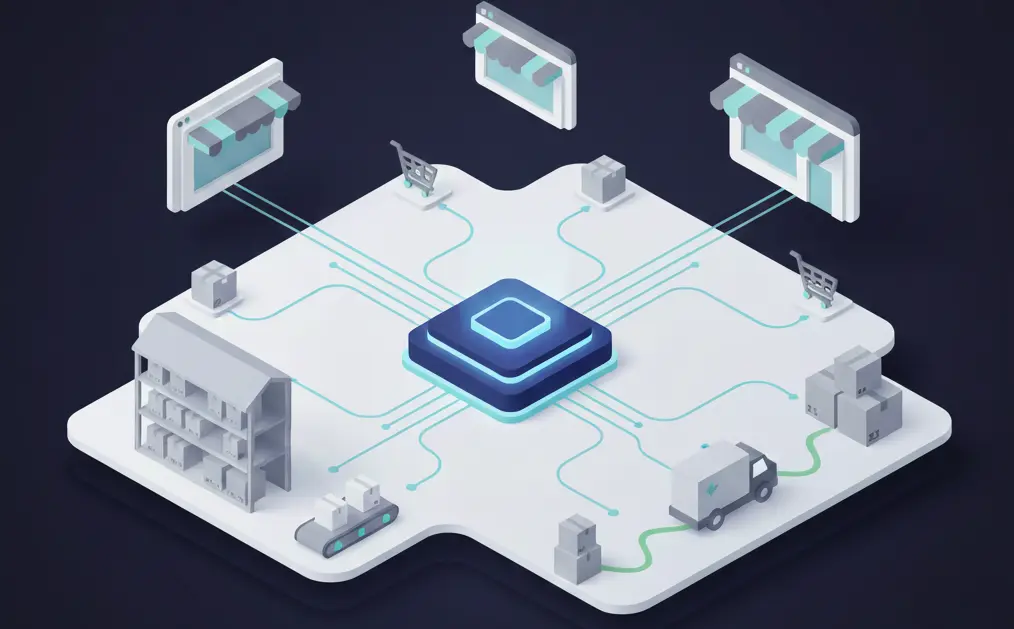
A multichannel order manager serves as a centralized hub that consolidates orders, inventory, and customer data across all sales channels into a single system. Instead of logging into five different platforms each morning to manually reconcile inventory, retailers gain real-time visibility across their entire operation.
Here’s the workflow: When a customer places an order on Amazon, the system immediately captures the transaction, updates inventory across all connected channels, routes the order to the optimal fulfillment location based on proximity and stock availability, and triggers automated shipping workflows.
Like Willow Commerce, automated solutions streamline operations by managing products, catalogs, SKUs, promotions, inventory, orders, purchasing, fulfillment, and shipping from a single platform. The system accelerates order fulfillment by managing warehouse operations and automating shipping flows, helping retailers select cost-effective carriers while maintaining real-time stock levels across marketplaces.
What Problems Does Multichannel Order Management Solve?
The operational chaos of multichannel selling creates predictable failure points. Inventory discrepancies lead to overselling, manual order entry consumes hours daily, and shipping delays erode customer trust. Each additional sales channel exponentially increases complexity.
Multichannel inventory sync presents a paradox: to grow revenue, businesses must expand into new channels, yet each new channel adds data management for order syncing, shipping, and fulfillment. The core challenge is synchronizing inventory across all active sales channels in real time.
Without automation, retailers face stockouts during peak demand, miss sales opportunities from inaccurate availability data, and waste capital on safety stock to buffer against uncertainty.
Key Features to Look For in Multichannel Order Managers
Not all order management systems are created equal. The difference between a tool that streamlines operations and one that creates new headaches comes down to specific capabilities.
| Feature | Why It Matters | Key Capabilities |
| Real-Time Inventory Sync | When inventory levels aren’t updated instantaneously across platforms, discrepancies arise, leading to overselling | Over 150 integrations enable seamless real-time synchronization |
| Automated Order Routing | Reduces shipping costs and delivery times by selecting the optimal fulfillment location | Intelligent routing based on proximity, stock availability, and cost |
| Centralized Dashboard | Provides a single source of truth for all operations | Unified visibility into profitability, inventory, and sales velocity |
| Multi-Warehouse Support | Essential for distributed inventory and regional fulfillment | Effective warehouse inventory management across locations |
| Automatic Reorder Points | Prevents stockouts through proactive inventory replenishment | Set automatic reorder points to maintain optimal stock levels |
Integration Capabilities
The platform must connect with your existing technology stack. Large enterprises retained a 59.6% market share in 2024, driven by global rollouts integrated with complex ERP landscapes, but SMEs need similar connectivity without enterprise budgets.
Willow Commerce exemplifies this approach with 150+ integrations spanning marketplaces (Amazon, eBay, Walmart, Etsy, TikTok), social commerce (Instagram), and shipping carriers, providing the connectivity retailers need without custom development. This extensive integration ecosystem ensures businesses can unify their operations regardless of where they sell.
Automation and Workflow Capabilities
Manual processes drain resources and introduce errors. One global footwear retailer implemented order management automation, achieving 94% order automation, significantly reducing errors and saving over 1,000 hours/quarter.
Look for platforms that automate order confirmation, payment capture, inventory adjustments, shipping label generation, and customer notifications. Streamlined order fulfillment through managed warehouse operations and automated shipping flows helps businesses accelerate order fulfillment and select cost-effective shipping carriers.
What Are the Costs and ROI of Implementation?
Investment concerns often stall decisions on multichannel order management. Understanding the actual cost structure and realistic payback periods helps retailers build compelling business cases.
Cost Breakdown for Mid-Market Retailers
The total cost can range from $100,000 for an MVP to $400,000 for a complex solution with advanced capabilities, while modifications to existing solutions can start at $50,000. However, cloud-based solutions offer more accessible entry points.
Entry-level order management software starts at $600 per month for e-commerce retailers processing up to 500 orders. In comparison, medium-tier options begin at $1640 per month for businesses processing up to 5,000 orders.
| Cost Component | Range | Notes |
| Software Licensing | $680-$1640/month | Based on order volume |
| Integration Services | $5K-$20K | One-time setup for standard integrations |
| Training & Change Management | $2K-$8K | Department-specific onboarding |
| Internal IT Resources | 40-60 hours | Configuration and testing support |
On the other hand, Willow Commerce pricing is more straightforward without any hidden costs:
| Plan / Monthly Order Volume | Price/Month |
| Starter – Under 2,000 orders | $499 |
| Growth – 2,000 – 4,999 orders | $999 |
| Pro – 5,000 – 9,999 orders | $1,999 |
| Enterprise – 10,000+ orders | Custom pricing |
Expected ROI and Payback Period
Retailers typically see payback within 18-24 weeks through labor savings from eliminating manual entry, error-reduction savings from fewer chargebacks and returns, inventory carrying cost reductions through better forecasting, and shipping cost optimization through intelligent carrier selection.
One retailer’s Director of Omnichannel stated that achieving 2024 revenue targets would not have been possible without launching their order management system before Black Friday and Cyber Monday. The revenue protection during peak periods alone can justify the investment.
How to Handle Inventory Across Multiple Channels?
Inventory management separates successful multichannel retailers from those drowning in spreadsheets. The synchronization challenge isn’t just technical; it’s about business logic, allocation rules, and real-time decision-making.
The Inventory Synchronization Challenge
When systems don’t sync well, retailers either overstock or run out of high-demand items. Real-time updates fix this by adjusting inventory across all channels as soon as a sale occurs. Safety stock prevents overselling, and smart allocation uses past performance and current trends to distribute inventory where it’s needed most.
Setting Reorder Points and Safety Stock
Automation gives teams real-time backorder alerts and replenishment reports. When an item drops below its reorder point, the system notifies them instantly.
Reorder Point = (Average Daily Sales × Lead Time) + Safety Stock. Safety stock varies by demand pattern and service level; high-velocity products need tighter buffers.
By automating reorder points, modern systems remove guesswork and help retailers maintain optimal stock across every channel, turning replenishment into a strategic advantage.
What Are Common Pitfalls and How Do You Avoid Them?
Even well-planned implementations face predictable obstacles. Understanding these failure points before launch prevents costly mistakes and accelerates time-to-value.
Pitfall 1: Underestimating Change Management
Technology only works when people adopt it. Teams see higher accuracy and efficiency when they understand the system and use it properly. Address resistance early through role-based training, peer support, clear communication of benefits, and incentives for adoption. Secure leadership backing to speed up the transition.
Pitfall 2: Ignoring Data Quality Before Migration
Poor data leads to failed implementations. Large custom builds often spend months correcting data issues. Audit and standardize inventory records, SKU formats, customer data, and order history before migration. Clean data prevents sync errors and duplicate orders. Set aside two to three weeks for this step.
Pitfall 3: Running Systems in Parallel Without a Clear Cutover Plan
Operating old and new systems together can be confusing if responsibilities are unclear. Define which system holds the truth, how long both will run, and what success looks like. Use a 48-hour reconciliation window and keep a manual review queue during the first week to ensure a smooth transition.
Key Takeaways
- Retailers using comprehensive order management systems reduce fulfillment costs by up to 28% and process orders 98% faster through automation, with some achieving 98% order automation rates.
- Real-time inventory synchronization across all sales channels prevents overselling, eliminates manual reconciliation, and enables businesses to maintain optimal stock levels while reducing carrying costs.
- Payback periods average 18-24 weeks through labor savings, error reduction, inventory optimization, and shipping cost improvements, with automation delivering 30-50% productivity gains.
- Change management and data quality are critical success factors; businesses that prioritize role-specific training and pre-migration data cleansing see 25% higher fulfillment accuracy.
- Automatic reorder points and intelligent allocation algorithms transform inventory management from reactive guesswork to proactive optimization, preventing stockouts during peak demand periods.
As Willow Commerce demonstrates, successful multichannel order management combines extensive integration capabilities, automated workflows, and real-time visibility to help retailers minimize costs, increase sales, and fulfill orders faster across all channels. By unifying operations through a single comprehensive platform, retailers gain the competitive advantage needed to thrive in today’s complex multichannel environment.
» Need a Multichannel Platform?
Related Posts