
Top 5 SellerCloud Alternatives for Omnichannel Sellers

Running an omnichannel ecommerce operation in 2026 means juggling inventory across multiple warehouses, syncing stock levels in real time, and shipping orders without overselling. SellerCloud has been a go-to platform for many mid-market sellers tackling these challenges, but it is not the only option.
If you have been using Descartes SellerCloud and feeling the friction, or if you are shopping for your first serious operations platform, this guide breaks down the top SellerCloud alternatives worth considering. We will look at what each platform does well, where they fall short, and help you figure out which one actually fits the way you sell.
Why Sellers Look for SellerCloud Alternatives
SellerCloud built its reputation on being a comprehensive solution for multi-channel merchants. The platform handles catalog management, multi-warehouse inventory, and custom workflow automation. For sellers doing serious volume across multiple channels, those capabilities matter.
But here is the thing: comprehensive does not always mean easy.
Pricing starts at $1,000 to $1,200 per month, with per-order transaction fees on top. As your volume grows, so does your bill. And if you need premium support? That will run you an extra $500 monthly.
The bigger issue for many sellers is the learning curve. Based on user feedback across G2, Capterra, and Software Advice, teams typically need 3 to 6 months to feel comfortable with the entire system. Some users report that basic customizations come with surprisingly high fees, and specific advertised integrations do not always work as expected out of the box.
Reviews from mid-2025 highlight ongoing issues with the multi-warehouse automation and Amazon listings modules, which are not fully functional. When you are paying enterprise-level prices, such gaps hurt.
None of this means SellerCloud is a bad platform. For sellers with technical teams who can troubleshoot independently and configure complex workflows, it remains powerful. But if you want faster time-to-value, more predictable costs, or a less steep learning curve, the SellerCloud alternatives below are worth a serious look.
How to Evaluate a Platform Switch
Before diving into specific platforms, let us talk about what actually matters when evaluating alternatives or competitors. Platform migration is not trivial. You are looking at inventory data migration, channel reconnections, team retraining, and potential sales disruptions during the transition.
Smart sellers think about the total cost of ownership, not just the subscription fee. Implementation costs, training time, ongoing maintenance, and third-party app expenses all add up. The average platform switch costs businesses around $8,400 in direct expenses plus 120 to 180 hours of team time. Getting your evaluation right upfront prevents expensive reversals.
Here is a practical framework:
Test before you commit. Most platforms offer trials or sandbox environments. Use them. Migrate a subset of your catalog, verify that your critical channel integrations work correctly, and confirm that reporting meets your needs before going all-in.
Map your pain points to features. Are you drowning in manual inventory updates? Is warehouse picking eating up hours? Do you need better demand forecasting? Different platforms excel at other things. Know what you actually need versus what sounds nice to have.
Consider your growth trajectory. A platform that works for 2,000 orders per month might not scale gracefully to 20,000. Make sure pricing and architecture support where you are headed, not just where you are today.
Quick Comparison: SellerCloud Alternatives at a Glance
| Platform | Best For | Core Strength | Starting Price | Key Limitation |
| Willow Commerce | Growing omnichannel brands | Unified ops with AI automation | $499/month | Migration planning needed for complex catalogs |
| Cin7 | Retail + B2B + Manufacturing | POS, B2B portals, production workflows | ~$399/month | Configuration complexity, consultant reliance |
| Linnworks | Multi-warehouse sellers | Inventory accuracy, order routing | ~$449/month | UI performance issues, steep learning curve |
| Extensiv (Skubana) | 3PLs and hybrid fulfillment | Order routing, fulfillment logic | ~$999/month | Long implementation, weaker listing tools |
| Rithum (ChannelAdvisor) | Enterprise retailers | Marketplace reach, feed management | Custom pricing | High cost, complexity, slow adoption |
1. Willow Commerce (Top Recommendation)
Willow Commerce takes a different approach than legacy platforms. Instead of bolting together separate modules for inventory, warehousing, shipping, and orders, Willow built a unified system where everything works together from day one.
What Makes Willow Commerce Different
The platform was designed specifically for today’s multi-channel reality. Native integrations with Amazon, Walmart, Shopify, eBay, Etsy, Target, TikTok Shop, Wayfair, Macy’s, and 150+ other channels mean you don’t have to wait months for critical marketplace connections. You connect, sync, and start selling.
Willow’s warehouse management system is built in, not bolted on. You get barcode picking, multi-warehouse support, real-time inventory sync, and shipping optimization all working together. Orders flow from any channel into your warehouse workflow without manual intervention.
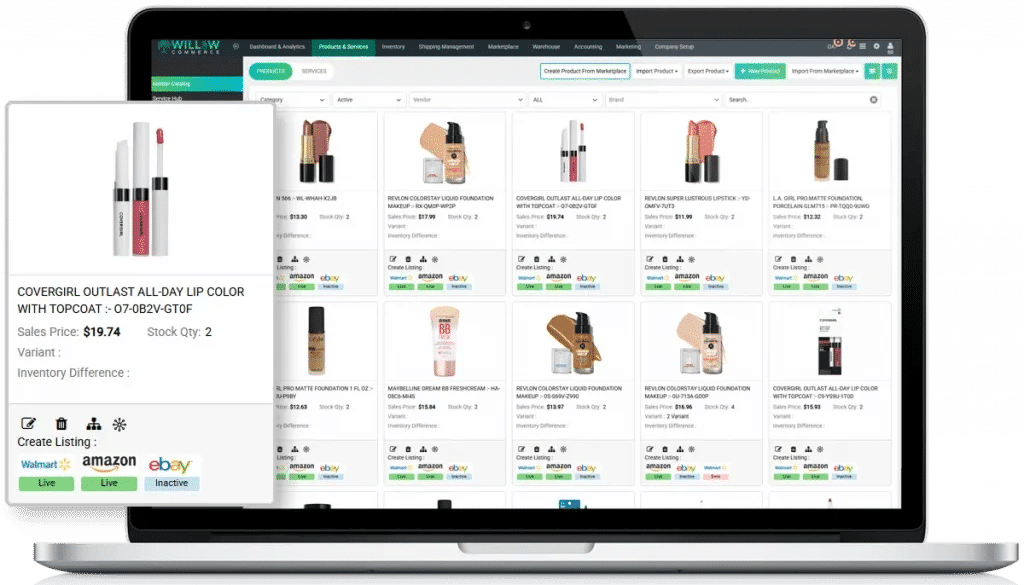
The AI-powered automation is where Willow really pulls ahead of older platforms. The system can automatically relist products across dozens of marketplaces, reroute orders to the cheapest warehouse location based on customer proximity, and forecast demand without requiring you to build complex rules from scratch. These are capabilities that legacy platforms either do not offer or require expensive add-ons to access.
Pricing That Actually Makes Sense
Willow uses flat, order-volume-based tiers with no hidden fees. Every plan includes unlimited users, warehouses, integrations, and products. No “per user” charges. No “per channel” fees. No surprise bills when your volume grows.
| Plan | Monthly Orders | Price |
| Starter | Under 2,000 | $499/month |
| Growth | 2,000 to 4,999 | $999/month |
| Pro | 5,000 to 9,999 | $1,999/month |
| Enterprise | 10,000+ | Custom pricing |
Compare this to SellerCloud’s $1,000+ minimum, per-order transaction fees, and premium support add-ons. For a seller doing 4,000 orders monthly, Willow’s all-inclusive pricing often works out cheaper than SellerCloud’s base tier plus fees.
Real Capabilities, Not Marketing Speak
Willow offers comprehensive modules for every aspect of ecommerce operations:
Inventory Management handles real-time stock sync across all channels, automatic low-stock alerts, multi-location tracking, and demand forecasting. No more spreadsheets. No more overselling because one channel didn’t update quickly enough.
Warehouse Management brings barcode scanning, pick/pack workflows, multi-warehouse routing, and 3PL integration into a unified interface. Warehouse teams can work faster with fewer errors.
Shipping Optimization automatically compares carrier rates, generates labels, and routes orders to minimize costs and delivery times. The platform integrates with FedEx, UPS, DHL, USPS, Amazon Shipping, and regional carriers.
Omnichannel Order Management centralizes orders from every sales channel, automates routing rules, and provides real-time visibility into order status across your entire operation.
Analytics and Insights delivers SKU-level profitability tracking, sales velocity reporting, and operational metrics to help you make data-driven decisions.
Onboarding and Support
Where legacy platforms often require months of implementation and thousands in consulting fees, Willow Commerce focuses on fast time-to-value. User reviews consistently mention an onboarding process that takes weeks rather than months, with dedicated support throughout. The team stays with you through implementation rather than handing you off after the initial setup.
Premium support is included at every tier; no extra $500 per month for the privilege of getting help when something breaks.
Best Fit
Willow Commerce works well for US-based brands selling across multiple marketplaces that want to reduce manual operations through automation without paying enterprise prices. If you are growing beyond 1,000 orders per month and finding that basic tools cannot keep up, but you are not ready for the cost and complexity of enterprise systems, Willow hits the sweet spot.

2. Cin7
Cin7 positions itself as a unified commerce solution for retailers, wholesalers, and manufacturers. It is powerful when you need to blend physical retail, B2B wholesale, and ecommerce operations into a single system.
Strengths
Native POS Integration sets Cin7 apart from platforms focused purely on ecommerce. If you run physical stores or pop-up locations alongside online sales, having POS and inventory in a single system eliminates much manual work.
B2B Ordering Portals let wholesale customers place orders directly, with custom pricing tiers and payment terms. For brands selling to retailers, this streamlines what would otherwise require separate systems.
Manufacturing Features include bill-of-materials tracking, production job management, and landed cost calculation. Simple assembly operations can be managed without needing a complete ERP.
Extensive Integrations with over 700 platforms covering accounting (QuickBooks, Xero), ecommerce (Shopify, WooCommerce, Amazon), shipping, and fulfillment.
Pricing
Cin7 offers two main products: Cin7 Core for smaller businesses and Cin7 Omni for more complex operations.
Cin7 Core starts at $349 per month, with pricing scaling up based on features and order volume. Cin7 Omni pricing is custom but typically runs higher, suited for businesses with multi-location, multi-entity requirements.
Common Pain Points
- Configuration complexity requires consultant assistance for advanced workflows, adding to the total cost.
- Intermittent performance issues with the system occasionally slow down during heavy use.
- Pricing structure can feel punitive for smaller businesses
- Frequent price increases have frustrated long-term customers
- Users often pay for broad platform access even when only using specific modules
Best Fit
Cin7 works well for retailers with physical stores and wholesale operations, brands with in-house manufacturing or assembly, and businesses that need a step up from QuickBooks without jumping to a complete ERP. If you are purely an online seller without retail or B2B components, other platforms may be more cost-effective.
3. Linnworks
Linnworks has built a strong reputation for inventory accuracy across multiple warehouses and sales channels. If keeping stock levels perfectly synced is your primary concern, Linnworks deserves serious consideration.
Strengths
Real-time inventory sync across 100+ marketplaces is Linnworks’ calling card. Users consistently report that overselling problems disappear after implementation. The system updates stock levels immediately when orders come in, regardless of channel.
Order Routing Automation lets you build sophisticated rules for how orders flow to warehouses or fulfillment partners, route by customer location, product availability, shipping method, or custom criteria.
Robust Integration Ecosystem includes marketplaces such as Amazon, eBay, Walmart, and TikTok Shop, shopping carts, shipping carriers, and 3PLs. The platform plays nicely with most of the tools that ecommerce sellers already use.
Warehouse Management capabilities include digital picklists, barcode scanning, and quality control functionality that helps teams pick, pack, and ship with fewer errors.
Pricing
Linnworks pricing starts around $449 per month for lower order volumes, scaling up with volume and additional features. Some sources indicate per-user pricing starting at $35 per month. Onboarding fees are standard, so factor that into your total cost calculation.
Common Pain Points
- UI performance issues, especially for larger accounts with extensive catalogs
- Interface can feel slow and dated compared to newer platforms
- Steep learning curve for complex setups requiring significant time investment
- Listing management capabilities lag behind inventory management strength
- Customer support quality appears inconsistent based on reviews, with some users reporting long wait times
Best Fit
Linnworks is ideal for sellers operating multiple warehouses or fulfillment centers where inventory accuracy is mission-critical. Brands prioritizing stock synchronization over listing speed will appreciate what Linnworks does well. If you already have strong listing tools and need a backend operations platform, it integrates smoothly.
4. Extensiv (formerly Skubana)
Extensiv came together from 3PL Central’s acquisition of Skubana, creating a platform that excels at complex fulfillment operations. If you run your own warehouses, work with 3PLs, or manage hybrid FBA/FBM fulfillment, Extensiv offers deep capabilities.
Strengths
Advanced Order Routing, with rule-based logic, automatically directs orders to the optimal fulfillment location based on inventory levels, shipping costs, customer proximity, and custom criteria. This is particularly valuable for businesses managing multiple warehouses or 3PL relationships.
3PL and Hybrid Fulfillment Support is where Extensiv shines. The platform was built by operators who understand the complexity of multi-node fulfillment networks. FBA, FBM, and 3PL workflows are all first-class citizens.
Demand Forecasting and Purchasing tools use real data across all channels to predict inventory needs and automate reorder points. No more guessing based on spreadsheets.
Strong Integration Network with major ecommerce platforms, marketplaces, shipping carriers, and warehouse management systems.
Pricing
Extensiv typically starts around $999 per month, with modular pricing that increases based on features and volume. Implementation can require a significant upfront investment, with some users reporting initial costs of $7,000+ or more.
Common Pain Points
- Long implementation timelines often take months to configure complex operations fully.
- Listing and product information management (PIM) capabilities are secondary to fulfillment strength.
- The platform has experienced growing pains since the 3PL Central and Skubana merger, with occasional bugs and system glitches.
- Cost is a barrier for smaller operations due to monthly fees and implementation expenses.
Best Fit
Extensiv is the right choice for 3PL operators, brands managing multiple fulfillment centers, and sellers with complex warehouse networks requiring sophisticated order routing. If fulfillment optimization is your primary challenge and you have the volume to justify the cost, Extensiv delivers.
5. Rithum (formerly ChannelAdvisor)
Rithum combines CommerceHub, ChannelAdvisor, and Dsco into an enterprise-grade commerce platform. With roots going back to 2001, it is one of the oldest players in the multi-channel software space.
Strengths
Massive Marketplace Reach across 420+ marketplaces and retail sites gives enterprise sellers unmatched distribution capabilities. If you need to sell on every possible channel globally, Rithum has the connections.
Product Feed Management handles the complexity of optimizing listings across hundreds of different marketplace requirements. For brands managing thousands of SKUs across dozens of channels, this automation matters.
Digital Marketing Integration allows you to manage advertising campaigns on Google, Facebook, Amazon, and other platforms alongside your channel operations.
Enterprise Scale with $50 billion in annual GMV processed across the platform. For large retailers and brands, Rithum has proven it can handle volume.
Pricing
Rithum uses custom enterprise pricing that varies based on business size, channel count, and required features. The platform often includes revenue-share or per-channel cost components. Expect enterprise-level budgets.
This is not a platform for sellers doing a few thousand orders per month. Pricing makes sense when your operations justify dedicated account management and enterprise service levels.
Common Pain Points
- High total cost of ownership with monthly fees, potential revenue-share, and extended contracts
- Steep learning curve and long onboarding process due to comprehensive capabilities
- Mid-market sellers often find Rithum overpowered for their needs
- Customer support experiences vary widely based on reviews
- Lacks built-in inventory management and warehouse functionality, requiring additional solutions
Best Fit
Rithum works for large enterprises with global marketplace operations, brands requiring presence across hundreds of channels, and retailers with dedicated ecommerce teams and enterprise budgets. If you are not operating at enterprise scale, other platforms will deliver better value.
Read more: Top 5 Rithum Alternatives
Comparative Pricing and Value Summary
| Platform | Starting Price | What is Included | Pricing Model | Best Value For |
| Willow Commerce | $499/month | Inventory, Orders, WMS, Multi-channel Sync, AI Automation, Unlimited Users/Warehouses | Order-volume tiers | Growing omnichannel brands want all-inclusive pricing |
| Cin7 | ~$349/month | Multi-channel Inventory, POS, Integrations | Tiered feature bundles | Retail/B2B mix with manufacturing needs |
| Linnworks | ~$449/month | Inventory, Order Routing, API Access | Volume-based tiers | Multi-warehouse sellers prioritizing inventory accuracy |
| Extensiv | ~$999/month | Fulfillment Logic, 3PL Support, Order Routing | Modular + volume | 3PLs and fulfillment-heavy operations |
| Rithum | Custom (enterprise) | Marketplace Feeds, Catalog Control | Custom/Revenue share | Enterprise retailers with global operations |
Which Platform Should You Choose?
Choose Willow Commerce for modern, unified operations with AI automation, predictable pricing, and fast onboarding. It is the best all-around SellerCloud alternative for 2026, matching SellerCloud’s operational depth while eliminating module fatigue and pricing complexity.
Choose Cin7 if you blend physical retail, B2B wholesale, and ecommerce, and need POS integration or light manufacturing capabilities in a single system.
Choose Linnworks if inventory accuracy across multiple warehouses is your primary concern and you have strong existing listing tools.
Choose Extensiv if you operate as a 3PL, manage complex fulfillment networks, or need sophisticated order routing across multiple fulfillment nodes.
Choose Rithum if you are an enterprise retailer requiring global marketplace reach across hundreds of channels and have the budget to match.
For most US-based omnichannel sellers looking to move beyond SellerCloud in 2026, Willow Commerce represents the most straightforward path forward. It combines the operational depth you need with modern automation and transparent pricing that grows with your business.
Is Willow Commerce a direct replacement for SellerCloud?
Yes. Willow covers inventory, orders, warehouse management, shipping, and multi-channel listings in one unified platform. Most SellerCloud users find comparable or better functionality.
Which ecommerce omnichannel platform is easiest to adopt?
Willow Commerce typically offers the fastest onboarding, measured in weeks rather than the months familiar with legacy enterprise tools.
What is the best SellerCloud alternative for inventory management?
Willow Commerce offers the most comprehensive all-in-one solution. For sellers focused specifically on inventory accuracy across warehouses, Linnworks also performs well.
Which alternative works best for omnichannel ecommerce?
Willow Commerce was explicitly designed for multi-marketplace and omnichannel operations
Is SellerCloud better than Willow Commerce?
SellerCloud offers deep customization for sellers with technical teams who can configure complex workflows. Willow Commerce is easier to scale and operate, with more transparent pricing and faster time-to-value
Which alternative is best for 3PL operations?
Extensiv remains the industry standard for 3PL-specific workflows, despite higher costs and longer implementation times.
How long does migration actually take?
Depends on your catalog size and complexity. Willow typically gets sellers operational in 2 to 3 weeks. Cin7 and Linnworks can take longer to set up for complex setups. Budget 4 to 8 weeks to be safe.
Will I lose sales during the switch?
Not if you plan it right. Run both systems in parallel for a week or two. Process orders in both until you trust the new platform. Then cut over.
Is Willow Commerce really that much cheaper than SellerCloud?
For most mid-market sellers, yes. Add up your SellerCloud base fee, transaction fees, and premium support costs. Compare to Willow’s flat rate. The math favors Willow, especially as your volume grows
» Start Your Free Trial
Disclaimer: The information presented in this article is based on publicly available data, customer feedback, and third-party research sources. Willow Commerce is not affiliated with Descartes Sellercloud, Cin7, Linnworks, Extensiv, or Rithum. All product names, trademarks, and brand references are the property of their respective owners and are used solely for identification and comparison purposes. This analysis is provided exclusively to help ecommerce businesses evaluate available software options. Product features, pricing, and capabilities may change over time, so readers should verify details directly with the respective vendors. Willow Commerce does not claim endorsement, partnership, or association with any third-party platforms mentioned and makes no guarantees regarding the accuracy or completeness of external information.
Related Posts